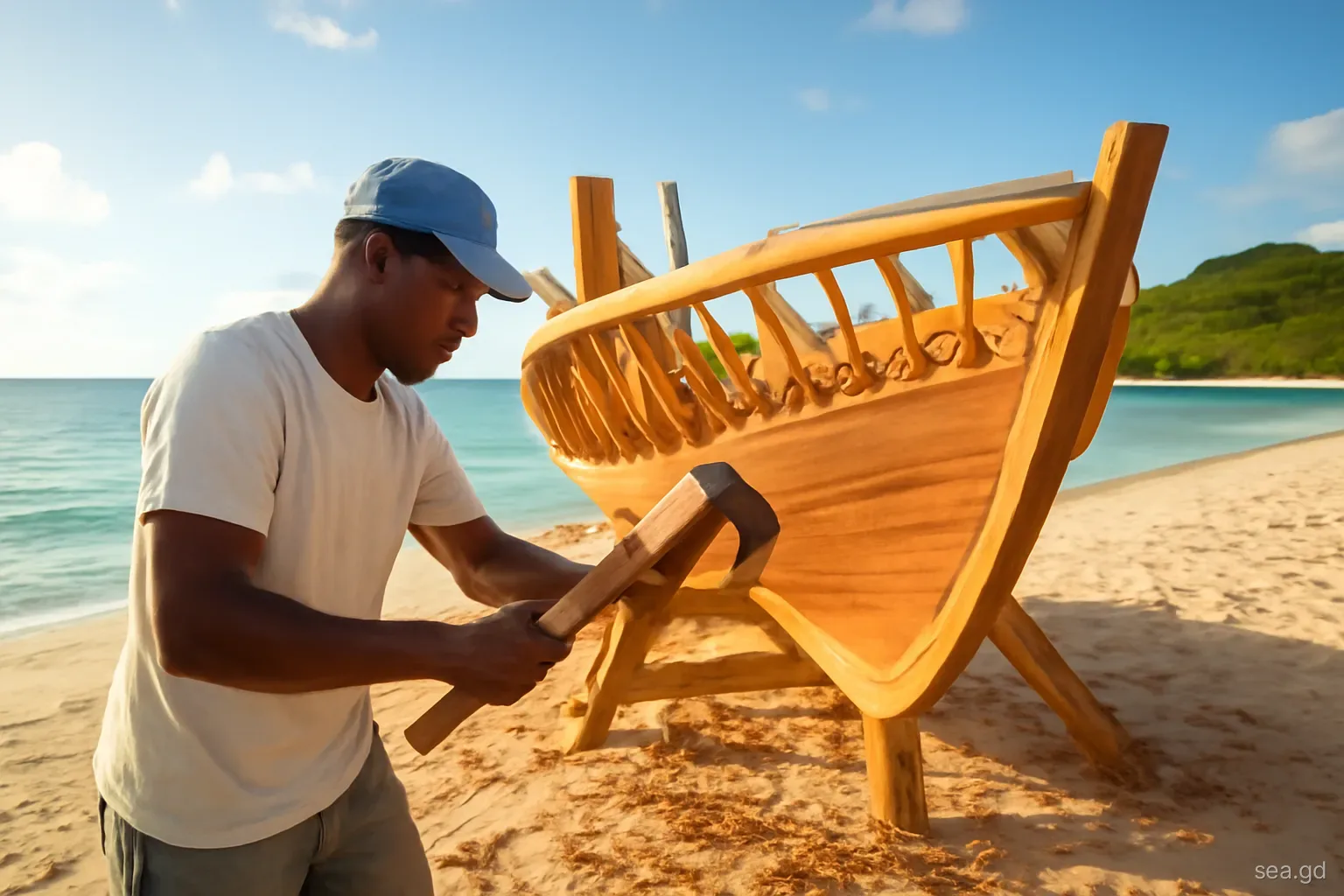
Long before fibreglass charter yachts filled Grenada's bays, the islands were sailed by locally built wooden boats, and in a few places they still are. The village of Windward on Carriacou's north-east coast became known across the Eastern Caribbean for its sloops and schooners, built on the beach by eye and by family tradition, and Petite Martinique shares the same seafaring culture. On the main island, small open workboats were used for fishing, and racing them became a fixture of local regattas.
This is not a museum subject. Boats are still built, repaired and raced, and the regatta season is one of the best ways for visiting sailors to understand how islanders have used the sea. What follows explains how these boats are made, how they handle, where you can see them, and how to watch or photograph them respectfully.
Where the tradition came from
The usual account traces Carriacou's boatbuilding to the late eighteenth and nineteenth centuries, when Scottish shipwrights and settlers brought their methods to the island and passed them on to African-descended Carriacouans who made the craft their own. Whatever the precise lineage, by the twentieth century Windward was turning out sloops and schooners that carried cargo, livestock and people between the Grenadines, Grenada, Trinidad and beyond.
Inter-island trade was the economic reason. Carriacou is small and dry, and its people lived from the sea: fishing, carrying goods and, by repute, a fair amount of informal trade across nearby borders. A sound, fast sloop was capital, and building one involved the whole extended family, with launching ceremonies that blend church blessing, food and drumming.
Engines and steel ferries took over most of the cargo work in the later twentieth century, and fewer large vessels are built today. The skills survived through racing, repair work and the steady demand for fishing boats, and the regatta became the public showcase of a living craft.
How a Carriacou sloop is built
By eye, not by drawings. Traditional builders work largely without plans. The shape of the hull comes from experience and from moulds or templates handed down, with the builder sighting along the frames to judge the curve. Two boats from the same yard are related but rarely identical.
Local and imported timber. Frames have traditionally been cut from naturally curved local hardwoods, chosen so the grain follows the shape of the frame for strength. Planking timber is often imported. The supply of suitable local trees has shrunk over the decades, which is one of the pressures on the craft.
Built on the beach. Boats are assembled on the shore within sight of where they will be launched. Keel first, then stem and stern posts, then frames, then planking, caulking and paint. A larger vessel can take many months, sometimes years, depending on money and labour.
The rig. The classic Carriacou sloop carries a single mast with a large mainsail and a headsail, set up for reaching across the trades between islands. Racing versions carry generous sail area and rely on crew weight to keep them upright.
Open workboats and how they race
Racing classes at Grenadian regattas typically run from small open boats sailed by a few crew up to larger decked sloops. The smaller open workboats are light, low and wide, often without a deep keel, and depend on crew moving their weight to the windward side, and in some classes out on planks or simply sitting high on the gunwale, to stay upright. Sail areas are large for the hull size, so in a gust the crew move fast or the boat fills.
Races are usually sailed close inshore along a beach, which makes them easy to watch. Starts can be lively, with boats jockeying for position under noisy instruction from crew and spectators alike. Capsizes and swamped boats are part of the spectacle, and rescue is generally informal, carried out by nearby boats.
Fishing villages along Grenada's coasts, including communities on the west and south coasts, have produced boats and crews for these races, and rivalries between villages and islands add a strong local flavour. For visiting sailors used to handicap rules and protest committees, it is a reminder that the sport began with working boats and pride.
Where and when to see them
Dates shift from year to year, and some events have changed since Hurricane Beryl hit Carriacou and Petite Martinique in July 2024, so confirm the current calendar with organisers or the Grenada Tourism Authority before planning around any of these:
- The Carriacou Regatta Festival, traditionally held around the first weekend of August near Emancipation Day, is the best-known showcase, with sloop and workboat races off Hillsborough alongside onshore festivities.
- Petite Martinique has its own regatta tradition, historically associated with the Whitsuntide holiday weekend.
- Workboat races have often been included in Grenada's main yachting events early in the year, with races held off Grand Anse beach.
- Village and fisherfolk regattas on the main island take place through the year, often linked to fishermen's celebrations around the end of June.
- Outside regatta time, a walk along the shore at Windward on Carriacou may show boats under construction or repair. Ask before entering a yard or photographing people at work.
Watching respectfully and common mistakes
Visiting yachts are welcome spectators, but racecourses are not marked like international events, and boats can come at speed from unexpected angles. The most common mistake is anchoring or motoring across the course. Anchor well clear of the start area and the beach marks, keep dinghies out of the racing lanes, and take local direction if a committee boat or official asks you to move.
Photographers should remember that a capsized crew is busy, not posing. Keep distance, stay downwind of the action so you do not take their breeze, and never approach a swamped boat unless asked for help. Drones are increasingly restricted around public events; check whether they are permitted and fly well clear of crowds.
Ashore, building yards are workplaces and family property. Asking before you walk in, buying from local vendors and showing genuine interest go a long way. Shipwrights may be happy to talk about their work, but they are not tour guides, and their time is worth respecting.
Why the tradition matters for today's sailors
Understanding the local boats explains a great deal about how islanders read the sea. Carriacou sailors learned to judge the channels between islands, the set of the current and the behaviour of the trades without electronics, because their livelihood depended on it. Many fishermen around Grenada still navigate largely by landmarks and experience, which is worth remembering when you meet a small, unlit boat at dusk or see fish pots in a channel.
The tradition is also fragile. Timber is harder to find, younger people have other options, and hurricanes can wipe out boats and yards in a night, as Beryl did in 2024. Cultural organisations and boatbuilders in Carriacou have worked to record the methods and keep apprentices involved, and regatta crowds and visiting sailors are part of what keeps the boats racing.
For anyone sailing the Grenadines, seeing a Carriacou sloop under full sail, crew stacked on the windward rail, is a useful correction to the idea that the region is only a backdrop for charter holidays. It is a seafaring culture with its own skills and history.
The fishing boats you will meet on the water
The working descendants of this tradition are the small fishing boats that visiting yachts encounter every day. Many are open wooden or fibreglass pirogue-style boats with outboard engines, setting out from beaches and landing sites such as Gouyave, Grenville, Victoria and the fishing communities around St George's and the south coast. Some still carry a sail for emergencies.
These boats often work without navigation lights before dawn and after dark, and they may be stationary while tending lines or fish pots. Fish pots are marked by small floats, sometimes just plastic bottles, and lines can stretch between them. Running over a pot line can foul a propeller, cost a fisherman his gear and income, and leave a yacht disabled near a lee shore.
Courtesy goes a long way: slow down near working boats, pass astern rather than ahead when they are hauling, and keep a proper lookout on approaches to fishing villages. Some fishermen offer fresh catch to anchored yachts; buying directly supports the same communities that keep the boatbuilding tradition alive.
Frequently asked questions
What is a Carriacou sloop?
A Carriacou sloop is a traditional wooden sailing boat built mainly in the village of Windward on Carriacou, usually without formal plans, using methods passed down through families. It carries a single mast with a mainsail and headsail and was historically used for inter-island cargo, fishing and racing.
When is the Carriacou Regatta?
The Carriacou Regatta Festival has traditionally taken place around the first weekend of August, close to Emancipation Day. Dates and programmes can change, and the island has been rebuilding since Hurricane Beryl in 2024, so check the current year's schedule before planning a visit.
Can visitors crew on a workboat in a regatta?
Crews are usually drawn from local communities and families, and places are rarely open to visitors. You may be invited if you have local connections or skills to offer, but most visitors enjoy the racing as spectators from the beach or from an anchored boat well clear of the course.
Are wooden boats still built in Carriacou?
Yes, though far fewer than in the past. Boatbuilding continues on a smaller scale, alongside repair work and fishing-boat construction. Timber supply, cost and hurricane damage have all made it harder, but the craft remains part of island identity.
Where can you watch workboat racing on mainland Grenada?
Workboat races have often featured off Grand Anse beach during the main sailing events early in the year, and at fishing-village celebrations elsewhere on the island. Schedules vary annually, so ask locally or check with sailing organisers before going.