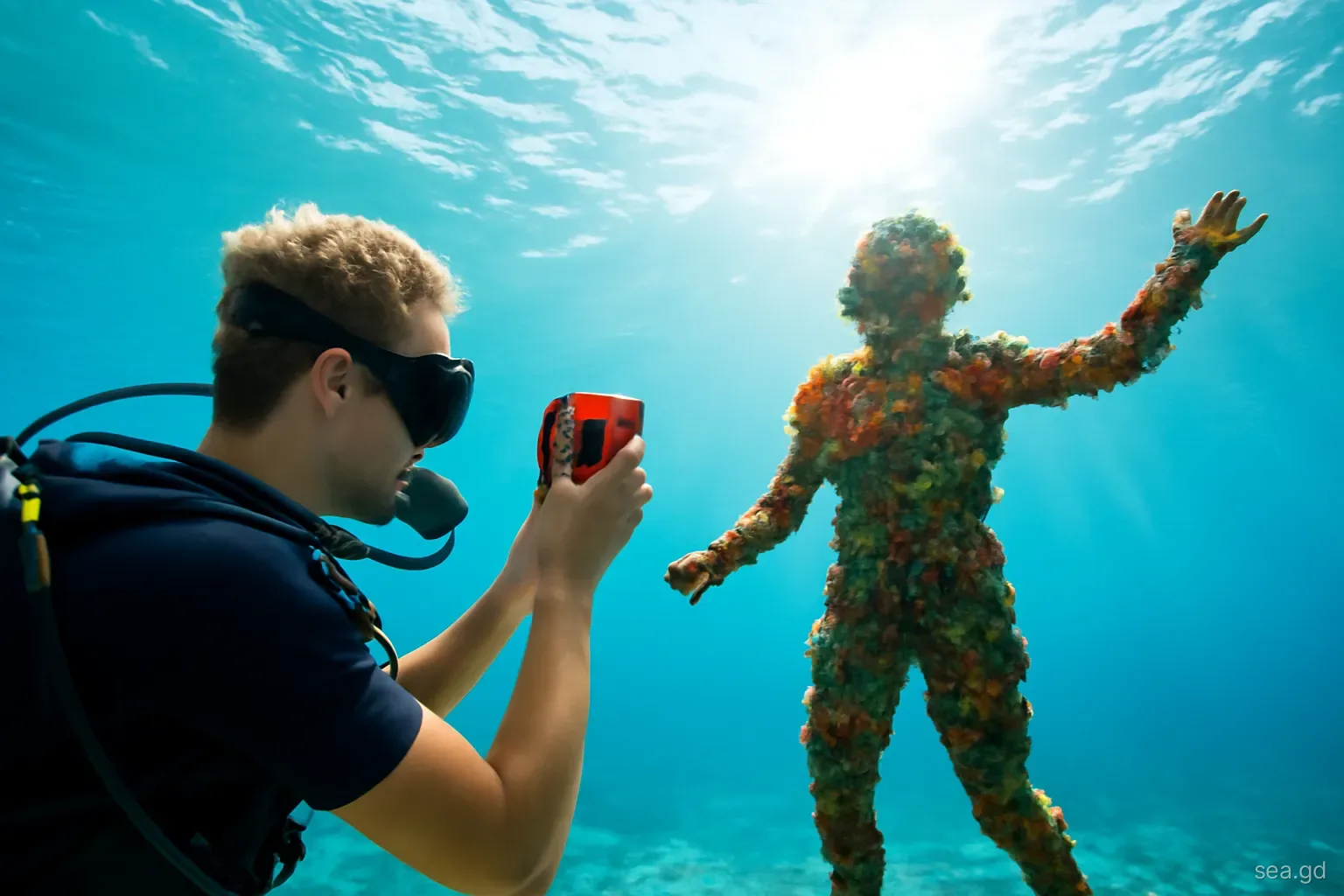
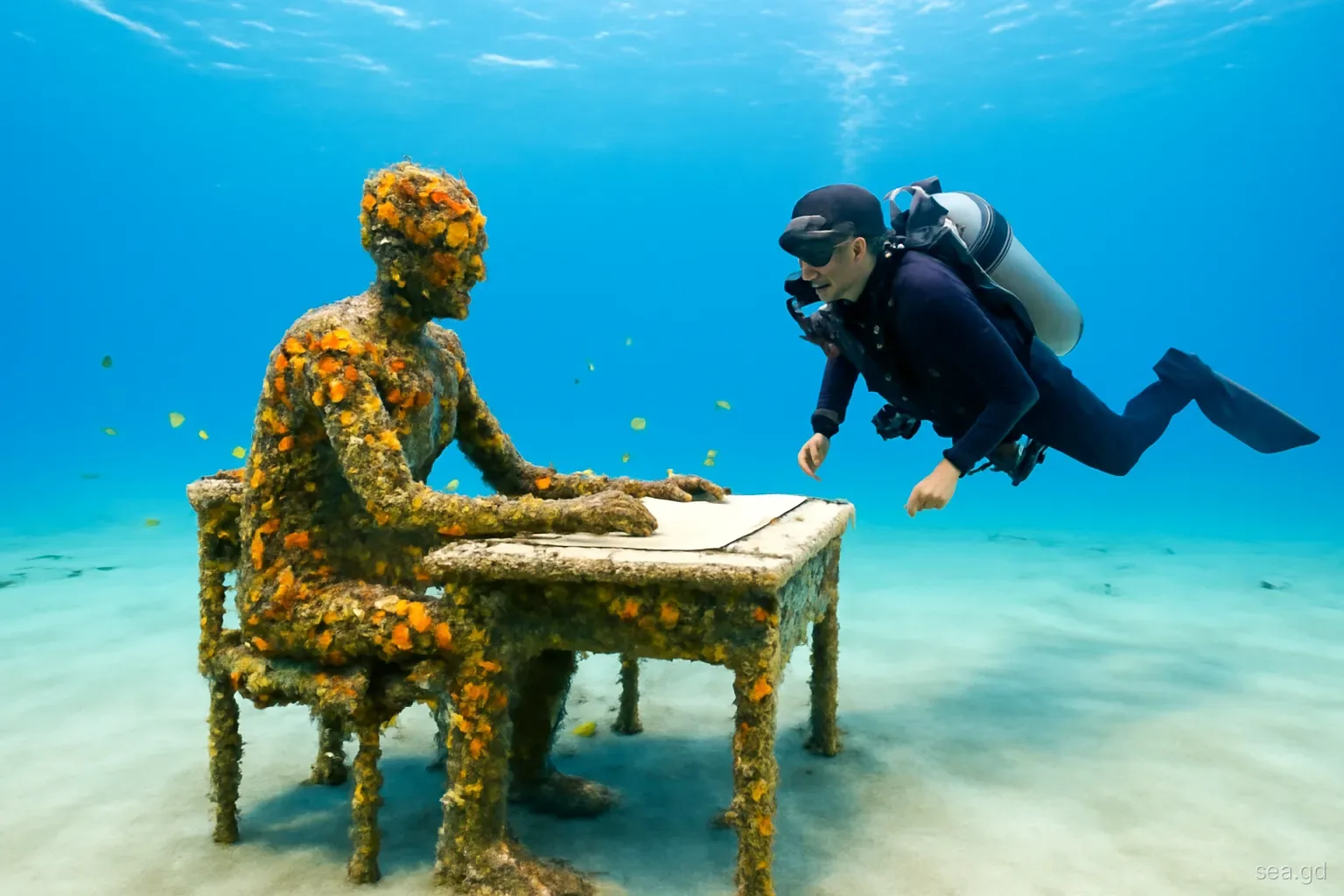
Snorkellers see the sculpture park as a pattern on the sand; divers see it as a place. Hovering at eye level with the figures, you can look into faces, around backs and under arms, and see the creatures that now live in and on the concrete. Because the main works lie shallow, it is one of the gentlest dives in Grenada and also one of the most distinctive.
The shallow depth brings its own challenges, mostly to do with buoyancy and surge, and the park is often dived as a short add-on when it deserves more time. This page covers what the dive is like, who it suits, how to dive it well and how to combine the sculptures with the natural reef around Moliniere Point.
What the dive is like
The sculptures sit mostly at depths between a couple of metres and around eight metres, on sand patches separated by sections of reef and rubble. A dive here is typically a slow, guided tour from piece to piece, starting from a mooring and following the guide through the different groups. Many operators run it as the second, shallower dive of a two-tank morning after something deeper elsewhere on the coast.
With such modest depths, air lasts a long time and no-decompression limits are not a constraint. A dive of an hour is easily possible for most people, and the main limits are usually the operator's schedule and how cold you get. Water temperatures are warm year-round, typically between about 26 and 29 degrees Celsius, but an hour of slow diving still feels cool for some people in a thin suit.
Visibility is often good, but it varies. The bay is close to land, so heavy rain brings sediment, and swell stirs up sand. On a clear day you may see several sculptures at once; on a poorer day each piece emerges from the blue as you reach it.
Who the dive suits
Newly certified divers. Shallow, sheltered and guided, it is an ideal early dive after an Open Water course, provided you can control buoyancy reasonably well.
Students on a course. Some operators use the park and nearby sand areas for training dives because the depth suits skill practice. If you are learning to dive in Grenada, ask whether one of your course dives can be here.
Uncertified visitors. Try-dive or Discover Scuba programmes give non-divers a supervised first experience, normally after a briefing and a confined-water session. The park's shallowness makes it a popular choice for this.
Experienced divers and photographers. For those who can hover motionless, the park offers unusual compositions, close macro work on the encrusting life and the chance to study how artificial structures are colonised. It rewards a slow, deliberate dive more than a quick lap.
What divers see that snorkellers miss
The most obvious difference is perspective. From the surface you look down on heads and shoulders; from depth you see faces in profile, hands joined, figures standing against the light. In Vicissitudes, divers can move around the circle at the level of the children's faces. At The Lost Correspondent they can look across the desk at the typewriter and the seated figure.
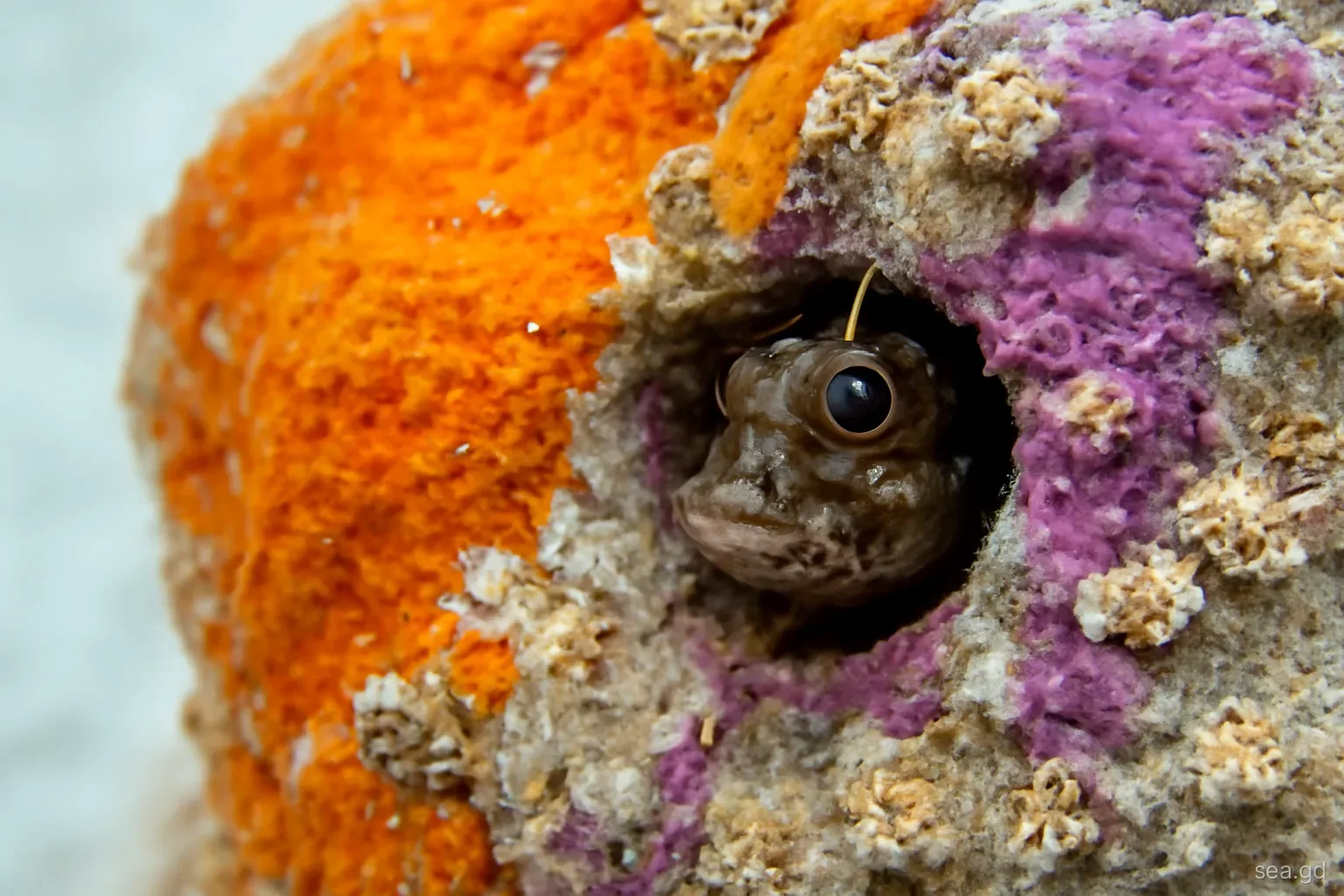
The second difference is life. The undersides and shaded parts of the sculptures support different growth from the sunlit tops, and crevices between figures shelter animals that do not show from above: small spiny lobsters, squirrelfish, juvenile fish, Christmas tree worms, colonies of tunicates and the occasional moray. Sergeant majors and damselfish guard territories on the figures, and patient divers often find tiny blennies peering out of holes in the concrete.
Finally, divers can explore the edges. Between the sculpture areas and around Moliniere Point there is natural reef with brain and star corals, sea fans and sponges, and the transition between art and reef is one of the most interesting parts of the dive.
Diving it well: buoyancy and technique
Shallow dives are harder than they look, because small changes in lung volume have a big effect and any contact with the bottom or the figures causes damage.
- Get your weighting right. Overweighting is common on shallow dives and leads to kneeling on sand. Do a buoyancy check at the start, and ask the guide to adjust weights if needed.
- Hold a horizontal trim with knees bent and fins raised, and use a frog kick or small flutter kicks to avoid sending sand up into the water and onto the sculptures.
- Use breath control for fine adjustments rather than the inflator. Long, slow breaths give gentle lift; short exhalations bring you down a little.
- Stay off the bottom and at least an arm's length from the figures. Gloves are discouraged in many places precisely because they encourage touching.
- Watch for surge. On days with swell, water moves back and forth in the shallows. Keep extra distance from the sculptures so a surge cannot push you onto them.
- Keep track of the group and the boat. Snorkellers and boats are often overhead, so ascend slowly, look up, and use a surface marker if your guide asks you to.
Combining the park with other dives
Moliniere Point and the natural reef. Many dives extend from the sculptures to the reef along Moliniere Point, where coral cover and fish life are richer. Ask the guide to include this if the plan allows.
Neighbouring bays. Dragon Bay and Flamingo Bay, within the same protected area, offer reef diving and are sometimes combined with the park.
Deeper sites elsewhere. A typical two-tank morning might pair a deeper reef or wreck dive with the park as the shallow second dive, which suits nitrogen loading and air consumption.
Carriacou and the north. Divers with more time often split their trip between the leeward coast of the main island and the reefs and islets around Carriacou. The sculpture park is a good orientation dive at the start of such a trip, before the stronger currents further north.
Night dives. Some operators occasionally offer the park at night, when octopus, lobsters and feeding coral polyps change the character of the sculptures entirely. Ask whether this is available.
Questions to ask before you book
Dive operators in Grenada vary in group size, pace and how much time they give the park. A few questions when booking tell you what kind of dive you are paying for.
- How long will we spend at the sculptures, and will the dive include the natural reef at Moliniere Point?
- How many divers per guide? Smaller groups mean less sand kicked up and better views of each piece.
- Is the park the first or second dive of the trip, and what is the other site?
- Is the protected-area fee included in the price, and are there any other charges such as equipment hire or a fuel supplement?
- What exposure protection is provided, and is a full-length wetsuit available for divers who feel the cold?
- For try-dives: what is the minimum age, where is the confined-water session held, and what is the instructor-to-student ratio?
- What is your policy if swell or poor visibility makes the bay unsuitable on the day: reschedule, alternative site or refund?
Mistakes divers make here
The park is easy, which leads people to switch off. These are the slips that guides see most:
- Treating it as a throwaway second dive and finning quickly between pieces instead of slowing down to look.
- Kneeling on the sand to take a photo, which smothers growth on the figures with sediment.
- Posing with hands on the sculptures. Many images on social media show this; it damages the organisms and is against the rules.
- Forgetting about overhead traffic when ascending, especially on busy days with many snorkel boats.
- Underestimating cold on a long, slow dive and finishing chilled; a 3 mm suit is more comfortable than a shorty for an hour underwater.
- Not paying the protected-area fee or not checking whether the operator includes it.
Frequently asked questions
What depth is the sculpture park dive?
Most of the sculptures lie between about two and eight metres, with a few slightly deeper. That makes it a shallow, gentle dive suitable for newly certified divers and try-dive participants under supervision.
Do you need to be certified to dive the sculpture park?
Certified divers can join a guided dive at Open Water level. Uncertified visitors can take part in a try-dive programme with an instructor, which includes a briefing and confined-water practice before the open-water visit.
Is it better to snorkel or dive the park?
Snorkelling shows the overall arrangement from above and suits most visitors. Diving gives closer views of faces, details and the marine life on and around the figures. If you are certified and comfortable, diving gives the richer experience.
How long is a dive at the sculpture park?
Because it is shallow, air lasts well and a dive of fifty minutes to an hour is common. The limit is usually the operator's schedule or your comfort in the water rather than depth or air.
Can you dive the park from shore?
There is no practical public shore entry for divers, and swimming in from neighbouring beaches crosses boat traffic. Diving is done from boats using the protected-area moorings, normally with a local dive operator.