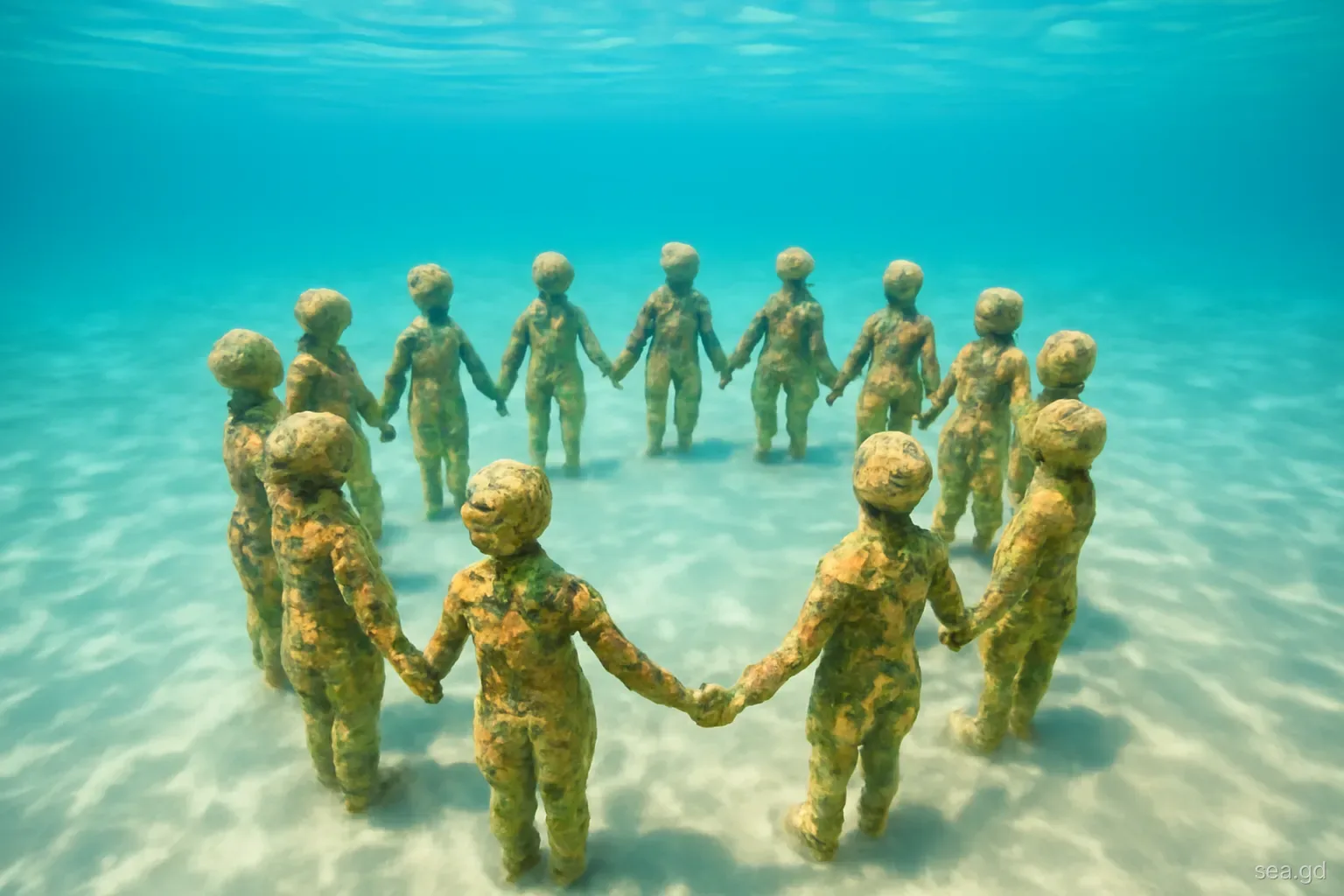
If you have seen one image of Grenada under water, it is probably this: a ring of children standing on pale sand, hands joined, faces turned outwards, their bodies softened by coral and sponge. Vicissitudes is the centrepiece of the Moliniere underwater sculptures and one of the most photographed artworks in the Caribbean.
It is also the sculpture people ask most questions about. Who were the children? What does it mean? Is it a memorial? Why does it look so different from the photographs? This page gathers what is reliably known about the work, the interpretations that have grown up around it, and how to see it clearly on a visit.
What the sculpture is
Vicissitudes was created by Jason deCaires Taylor and installed in Moliniere Bay in 2007, in the park's second year. It consists of a circle of life-size figures of children, usually counted at twenty-six, standing on the seabed facing outwards, each holding the hands of the figures beside them. The ring is set on sand in shallow water, roughly four to five metres deep, which places it within easy view of snorkellers on a calm day.
The figures were cast from real Grenadian children of different ages and backgrounds. That casting process, taking moulds of actual bodies and faces, gives each child an individual posture and expression, and is a defining feature of Taylor's work. In the years after installation the detail of clothes, hair and faces was crisp; today much of it is hidden under growth.
The title means changes of fortune, the ups and downs of life. Taylor's own descriptions emphasise the way the children, joined together, stand facing the changing environment around them, and the way the work itself changes as the sea colonises it.
The meanings people find in it
Almost from the start, visitors and commentators connected the ring of figures with the Middle Passage, the transatlantic slave trade that brought enslaved Africans to Grenada and the rest of the Caribbean, and with the people who died at sea on that crossing. Tour guides often present it that way, and many visitors leave with that reading. It is a powerful interpretation for a Caribbean island whose population descends largely from enslaved Africans.
It is worth knowing that this reading came largely from viewers rather than being the stated starting point of the work. The artist has spoken more about cycles of life, resilience, unity and the relationship between people and the natural world, and about the children representing a diverse community holding together. Both readings sit alongside each other, and the sculpture's openness is part of why it resonates.
A third layer of meaning is ecological. Children represent the future, and placing them on the seabed to become a reef, slowly absorbed into the ocean, speaks to the relationship between the next generation and the state of the sea they will inherit.
How the sculpture has changed
Year one to five. The figures were pale grey with sharp features, and early colonisation came mainly from thin films of algae and small encrusting organisms. Photographs from this period are the ones most often used in promotion.
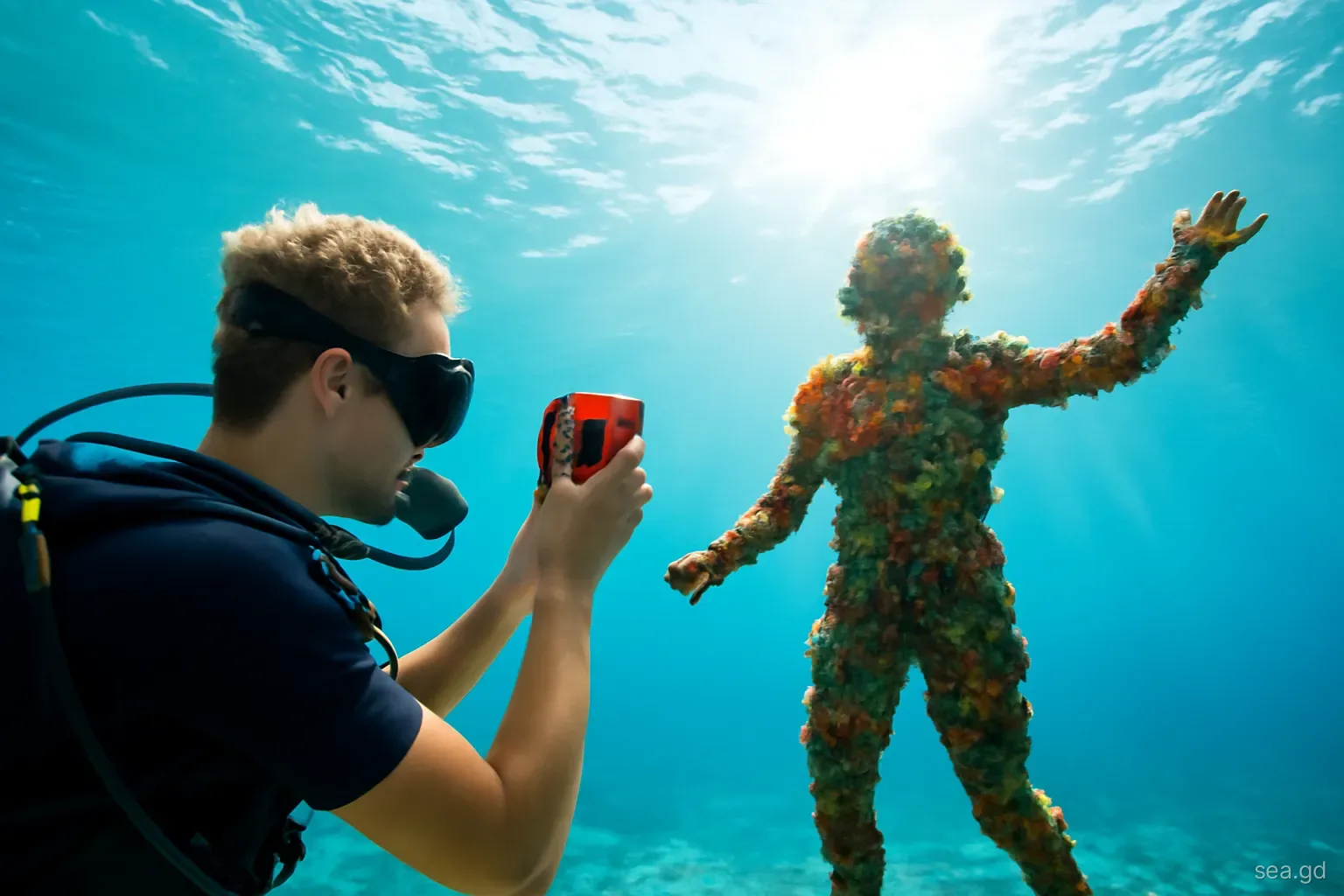
The middle years. Sponges, soft corals, hydroids and small hard corals spread across the bodies. Colour arrived: patches of purple, orange, yellow and green. Fish began to use the circle as shelter, and the figures started to look less like statues and more like reef.
Today. Growth is heavy on many figures, and some faces are barely recognisable. Upward-facing surfaces such as heads and shoulders carry the thickest growth. Some parts have suffered damage over the years, from swell and from careless contact.
What comes next. The intention was always that the reef would take over. Over decades the sculpture is expected to become increasingly indistinct, which is not neglect but the completion of the idea.
How the figures were made
Taylor's method for works like Vicissitudes begins on land with living models. The skin is protected, and a mould is taken of the body or face in a quick-setting material, which means the model has to hold still for some time while it cures. From that negative mould a positive is produced, refined, and then used to cast the final figure in marine cement.
For a group work the process is repeated for every figure, so a circle of children meant many separate casting sessions with many young sitters, and then the logistics of moving heavy concrete figures to the coast, loading them onto a boat or lifting frame and lowering them into place. Positioning was done by divers working on the sand, with the figures fixed to the bottom so that ordinary swell would not topple them.
The cement mix was chosen to be free of harmful compounds and roughly neutral in pH, and the surfaces were left with enough texture for coral larvae to grip. In other words the sculpture was built from the outset to be colonised, not merely tolerated by the sea.
Vicissitudes and the work that followed
The idea of a crowd of cast figures standing together on the seabed became one of Taylor's signature forms. A few years after Vicissitudes, his installation The Silent Evolution at the MUSA underwater museum off Cancún placed hundreds of figures cast from people of the local community on the seabed, on a far larger scale. Later projects in the Bahamas and Lanzarote developed similar themes of people, change and the ocean.
Seen in that light, the ring in Moliniere Bay is the prototype: smaller, more intimate and, because it was among the first, now further along in its transformation than any of the later works. For visitors interested in art rather than only in snorkelling, that is a good reason to see it.
Seeing Vicissitudes well on a visit
The circle is easy to find with a guide, but a clear view depends on timing, conditions and your own technique in the water.
- Go with an operator who stops directly over the circle, rather than one dropping snorkellers at a general spot in the bay. Ask about this when booking.
- Choose a calm, sunny morning if you can. Light from overhead makes the figures stand out against the sand, and calm water gives the clearest view from the surface.
- Float face down above the circle and look straight down first, to see the full ring. Then move slowly around the outside to see the faces, which look outwards.
- If you are a competent breath-hold diver and the guide permits it, a slow, controlled duck-dive gives a closer look at the faces. Do not touch the figures or stand on the sand among them; fins stir up sediment.
- On a dive, approach at the height of the children's heads and keep well off the bottom. Divers have the best views of the hands and the details of individual figures.
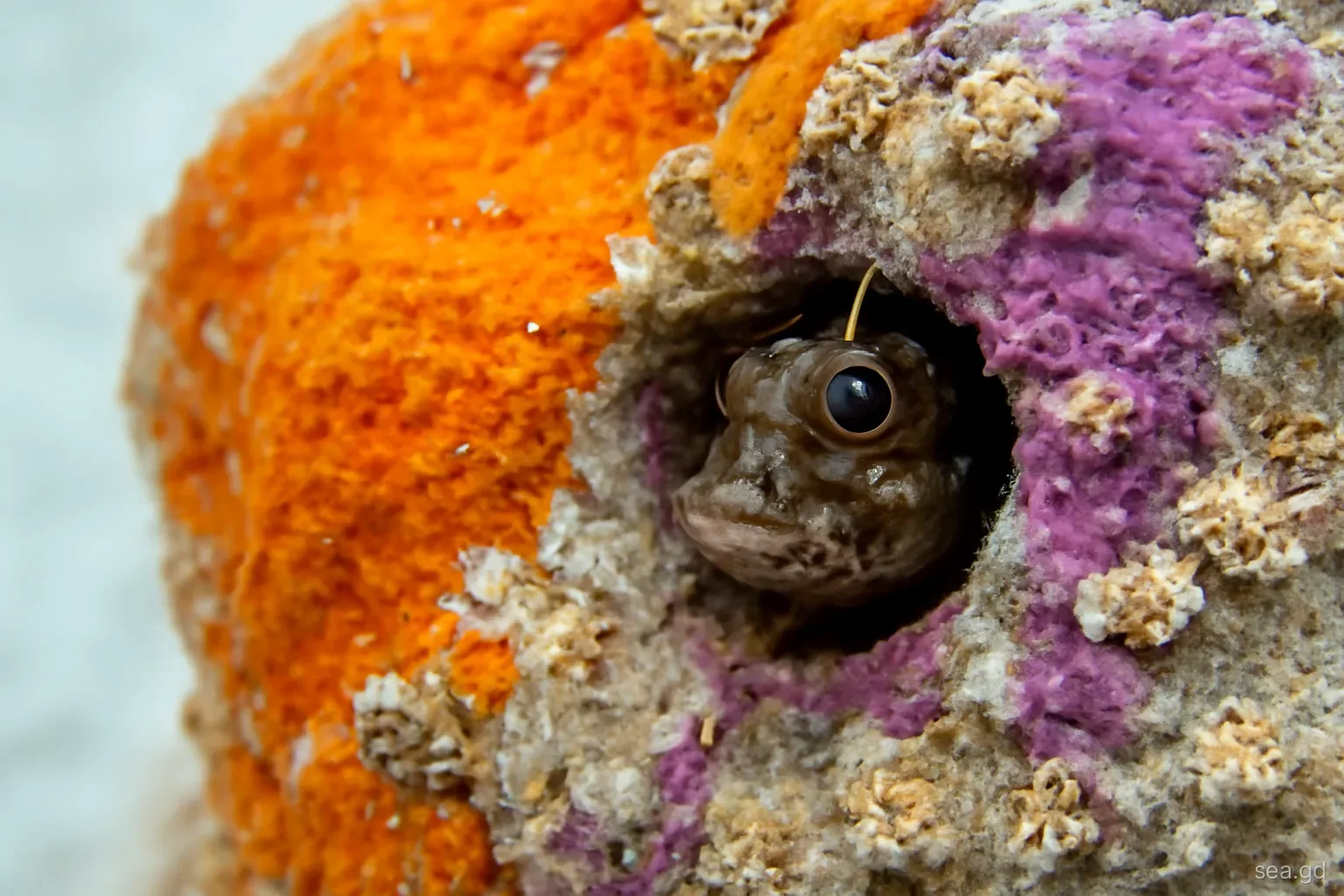
- Leave time to look at the life on the figures themselves: small fish sheltering between legs, sponges in strong colours, and occasionally a moray or lobster using the base.
Common misconceptions
A few claims about the sculpture circulate widely and are worth correcting or putting into context.
- It is a memorial to a specific shipwreck or event. No; it was not made to commemorate any particular event, though many people read it in the context of the Middle Passage.
- It is very deep and only for divers. It lies in a few metres of water and snorkellers can see it clearly in good conditions.
- The figures are bronze or stone. They are cast in marine cement, chosen so that marine life can attach easily.
- Someone is supposed to clean them. The growth is intended. Cleaning would destroy the living reef that has formed on them.
- It looks the same as in the photos. Most popular images are years old. Expect something more overgrown and organic, with its own appeal.
Frequently asked questions
How deep is Vicissitudes?
The circle stands on sand at roughly four to five metres. In clear, calm conditions snorkellers can see it well from the surface. Divers can view it from the level of the figures and see more detail of faces and hands.
How many children are in Vicissitudes?
The ring is usually described as twenty-six figures of children holding hands. They were cast from real Grenadian children, which is why each has an individual pose and expression.
What does Vicissitudes mean?
The word means changes of fortune. The artist has described themes of unity, resilience and change; many viewers also connect the work with the Middle Passage and enslaved Africans lost at sea. Both interpretations are commonly shared by guides.
Can you touch the sculptures?
No. They are inside a marine protected area, and the coral, sponges and other organisms on them are living and fragile. Touching, standing on or posing against the figures causes damage and is against the rules.
Why do the children look so different from the photographs?
Most widely shared photographs were taken in the early years, when the figures were relatively clean. Since then marine growth has covered much of their surface, which was always the intention behind the work.