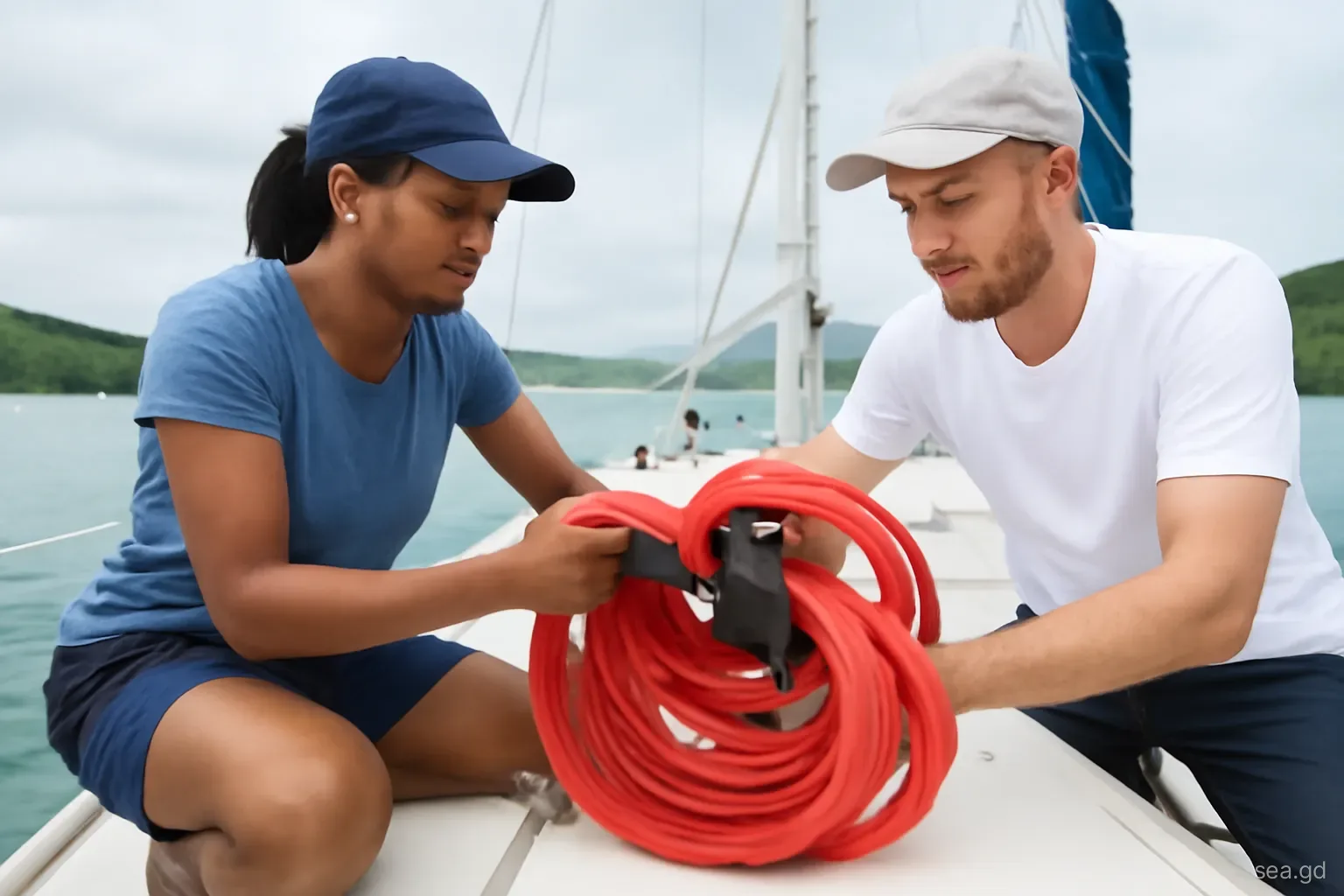
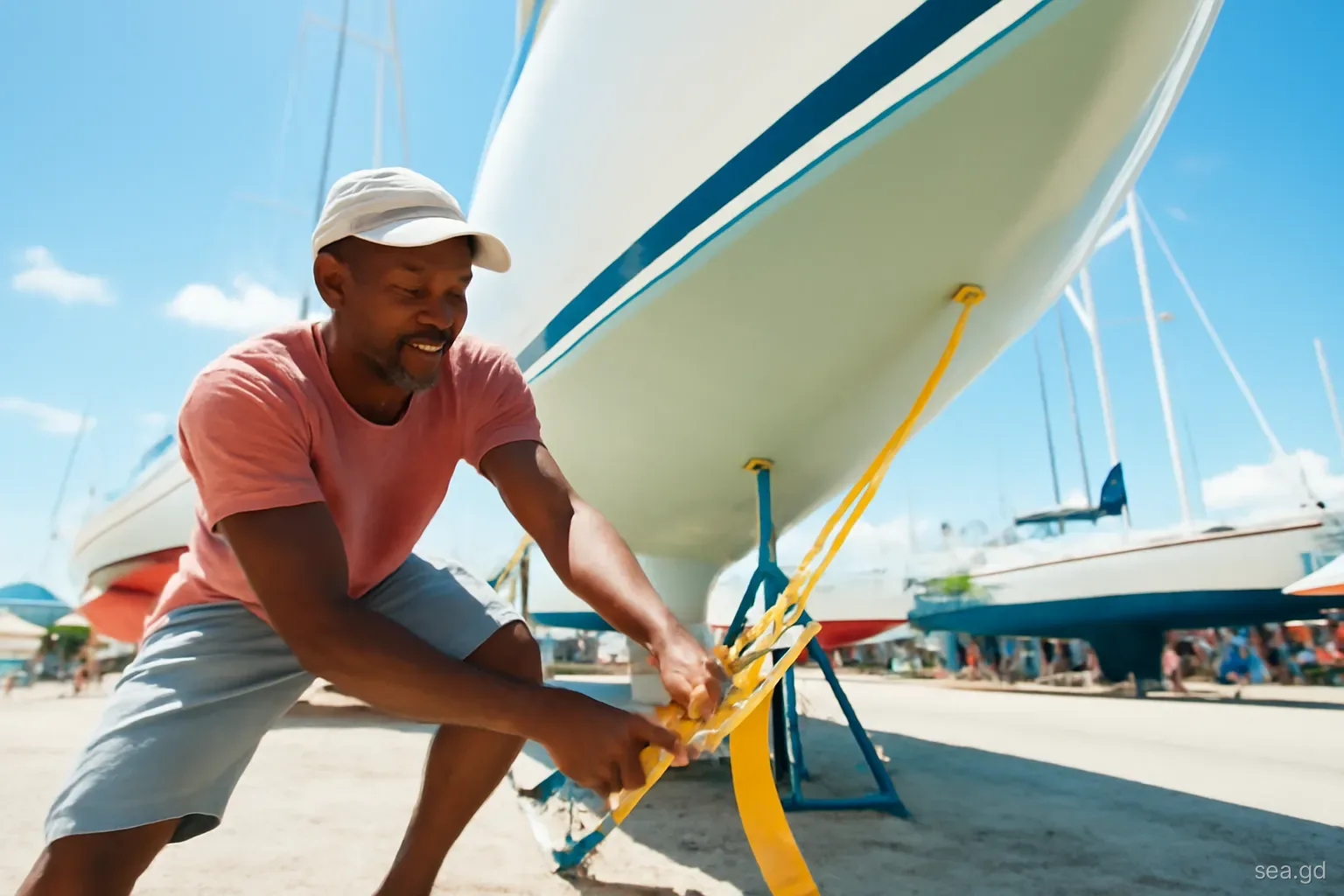
Hauling out and storing the boat ashore is the most common hurricane-season strategy for yachts in Grenada, and the one many insurers prefer. The south-coast yards, at Prickly Bay, Woburn Bay and St David's, and the yards in Tyrrel Bay in Carriacou, store hundreds of boats each summer while owners fly home. A boat on the hard cannot drag anchor, cannot be holed by a neighbour drifting through a crowded hole, and is not relying on a crew to tend lines.
It is not invulnerable. Hurricane Beryl in July 2024 toppled boats stored ashore in Carriacou, and Ivan in 2004 caused damage in yards on the main island. How a boat is supported, strapped, spaced and stripped makes a large difference to whether it survives a strong storm. This page explains the methods Grenada's yards use, what to ask before you book, and how to decommission the boat for months of absence.
How boats are supported ashore
Most monohulls in Grenada's yards stand on adjustable steel stands, with the keel resting on wooden blocks and several stands along each side pressing pads against the hull. Some yards offer welded cradles, which hold the hull in a fixed frame and are generally considered stronger in high winds. Catamarans sit on blocks under each hull, with lower profiles but a large area exposed to wind.
The support system matters because hurricane winds push on the hull, mast and anything left on deck, and a boat rocking on stands can work them loose. Once one stand shifts, the boat can lean and fall, and in a tightly packed yard a falling boat can take its neighbours with it. That chain reaction caused much of the damage in yards hit by major storms in the Caribbean.
Ask the yard how many stands it uses for a boat of your size, whether stands are chained together across the hull so that they cannot splay, and whether cradles are available. Some yards in the region have experimented with burying keels in shallow pits to lower the centre of gravity; ask whether this is offered and whether your insurer accepts it.
Tie-downs: straps to the ground
What they are. Tie-downs are straps or chains running from the boat, often over the deck or around the hull, to anchors fixed in the ground, such as concrete blocks or screw anchors. They resist the boat being lifted, rocked or blown over.
Who requires them. Many insurers covering boats ashore in Grenada during the season now require tie-downs, and the main yards offer them, usually as a separate charge. Some yards include tie-downs in hurricane-season packages; ask.
How they are fitted. Straps should be tensioned evenly, protected where they cross the hull and deck, and attached to genuine ground anchors rather than to stands or other boats. Check the yard's method and ask for photographs once fitted.
Carriacou yards. The two yards in Tyrrel Bay lost boats from their stands during Beryl and have been rebuilding capacity and equipment since. If you are considering laying up in Carriacou, ask specifically what support and tie-down systems are now in use, how much space there is, and whether your insurer accepts storage there during the season.
Limits. Tie-downs reduce risk but do not guarantee survival in a direct hit from a major hurricane. They work best combined with good stands, adequate spacing and reduced windage.
Questions to ask the yard before you book
Yards differ in methods, prices and rules. These questions bring out the differences.
- How are boats of my type supported: stands, cradles or another method? How many stands, and are they chained together?
- Are tie-downs available, what do they attach to, and what do they cost?
- How far apart will boats be stored, and how are tall-masted boats arranged relative to each other?
- Can or should the mast be removed, and what does that cost? Where are unstepped masts stored?
- What is the yard's storm plan: who checks boats before and after a storm, and how are owners informed?
- What does the yard require of owners before leaving: sails off, canvas off, dinghy stowed, batteries disconnected?
- What security and insurance does the yard itself hold, and what does the contract say about liability if a neighbouring boat falls on yours?
- Can the yard provide documents your insurer needs, such as a description of the storage method?
Decommissioning for the season
A thorough lay-up takes a couple of days. Most owners do it themselves, with yard help for lifting, mast work and tie-downs.
- Remove all sails, including furling headsails, and all canvas: bimini, dodger, sail covers and cushions on deck. Store them dry below or in the yard's storage.
- Remove or lash down wind generators, solar panels, antennas and anything else on deck. Take down halyards or tie them away from the mast to stop slapping and chafe.
- Flush the engine with fresh water, change oil and filters, and fog or protect it according to the manufacturer's advice for long storage.
- Empty and clean water tanks or treat them, pump out holding tanks and flush the heads with fresh water.
- Empty the fridge and freezer and all food lockers. Leave doors and lids propped open.
- Clean the interior with a mould-inhibiting solution, open lockers for airflow, and fit vents or a solar fan. Close hatches and portlights securely.
- Disconnect batteries or set up solar maintenance charging if the yard permits it.
- Close all seacocks; on the hard, cockpit drains must stay clear so rain cannot pool.
- Plug the exhaust and any openings where wasps, rodents or birds might enter.
- Photograph everything, give the yard a key and contact details, and confirm the tie-downs are fitted before you fly.
Masts up or masts down?
A mast adds a large lever arm for the wind to act on. In a direct hit, a boat with its mast stepped carries more load on its supports, and masts can strike neighbouring boats if a boat falls. Removing the mast reduces windage and risk, and some insurers and yards encourage it, especially for larger boats.
Unstepping is not free. It costs a crane or yard lift, rigger time, storage space for the mast, and the same again to restep, with the opportunity to inspect the rig adding further cost. For many cruising boats, owners leave the mast up but strip everything else from it, while for boats with older rigs the lay-up is a natural moment to unstep, inspect and replace standing rigging before restepping in the autumn.
Whichever you choose, ask how the yard spaces masted boats and whether it groups unmasted boats together. Discuss it with your insurer as part of your hurricane plan.
Mistakes owners make on the hard
Booking late. Yard space for the hurricane season fills early, especially after a damaging season elsewhere. Book months ahead.
Leaving the furling headsail on. A furled headsail can unwind in a strong wind and act as a sail, shaking the boat on its stands. Take it off.
Blocked drains. Leaves and dust can block cockpit drains on the hard. Water then floods the cockpit and finds its way below or adds weight high up.
No one checking. Arrange for the yard or a boat-watch service to inspect the boat after any significant weather and report back.
Assuming yard liability. Many yard contracts limit liability for storm damage. Your own insurance is what protects you, so read both documents side by side.
Leaving the dinghy and outboard on deck. A dinghy on deck or in davits is a large, light object that wind can lift and throw. Deflate and stow it below, or store it with the yard, and take the outboard off.
Forgetting about water ingress. Months of tropical rain find every weak deck fitting and hatch seal. A small leak that goes unnoticed for a summer can soak cushions, rot core and corrode wiring. Fix known leaks before laying up.
Frequently asked questions
Is a boat safer on the hard or in the water during a hurricane in Grenada?
Many insurers and yards consider a properly supported, strapped and stripped boat on the hard safer than one afloat, because it cannot drag or be struck by drifting boats. However, boats ashore can be toppled in a direct hit, as happened in Carriacou during Beryl. Preparation and spacing matter greatly.
What are hurricane tie-downs?
Tie-downs are straps or chains running from a boat on the hard to anchors fixed in the ground. They resist the boat being rocked or blown off its stands. Many insurers now require them for boats stored ashore during the season, and Grenada's main yards offer them for a fee.
Should the mast be removed for hurricane season?
Removing the mast reduces windage and the risk of damage to neighbouring boats, and some insurers and yards encourage it. It adds cost for unstepping, storage and restepping. Many cruisers leave the mast up but strip everything from it. Discuss the choice with your yard and insurer.
When should you book hurricane-season storage in Grenada?
Book as early as possible, ideally several months before the season. Yard space fills quickly for June, particularly after a damaging season elsewhere in the Caribbean. Confirm the support method, tie-downs, and the yard's storm plan in writing when booking.
Can you live aboard on the hard in Grenada?
Some yards allow short periods of living aboard on the hard, usually for a fee and with rules on ladders, toilets and waste water. During the hurricane season most owners lay up and leave. Ask the yard about its policy if you need to stay aboard while working on the boat.
Who checks the boat while the owner is away?
Most yards offer inspections, and independent boat-watch services operate around the south coast. Agree what is checked, how often, how you will receive reports, and what happens after a storm. Insurers may ask for evidence that the boat is checked regularly.