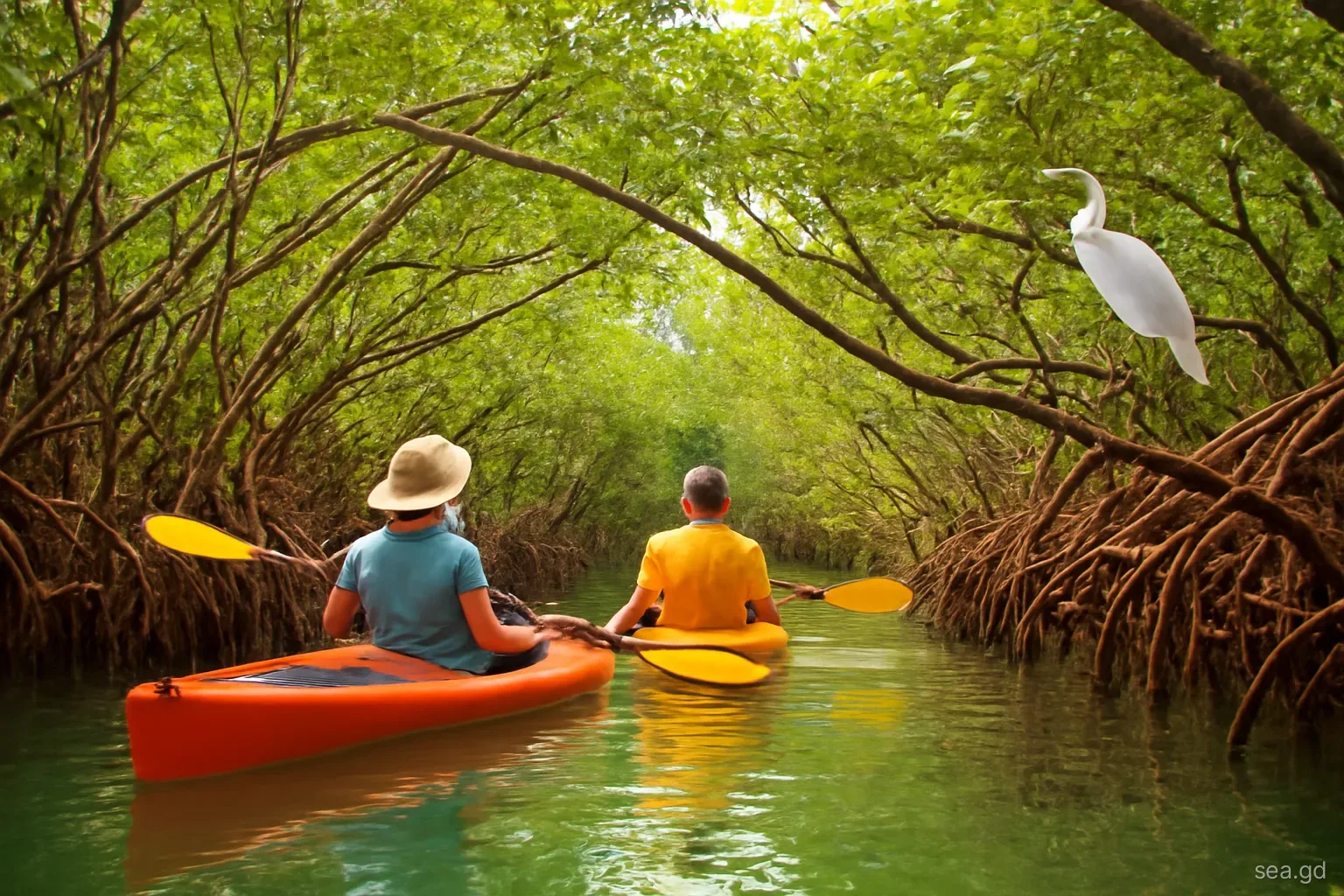
Most people come to Grenada's waters for the reefs, but the reef is only one part of a connected system. Close to shore, in sheltered bays and lagoons, mangrove forests and seagrass meadows do much of the work that keeps the reef healthy: they raise young fish, trap sediment that would otherwise smother coral, feed turtles and absorb the force of storm waves. Lose them, and the reef offshore suffers too.
Grenada and Carriacou still have important stands of mangrove and extensive seagrass beds, from the Oyster Bed lagoon at Tyrrel Bay to the bays around Woburn and the pond at Levera. This guide explains how these habitats work, where to see them, what threatens them and how to visit by kayak, dinghy or snorkel without leaving damage behind.
The mangroves of Grenada and Carriacou
Red mangrove. The species seen at the water's edge, with arching prop roots that hold the tree above the tide. Beneath the surface, the roots are crowded with sponges, oysters, small fish and juvenile snapper and barracuda sheltering from predators.
Black mangrove. Growing a little further back, black mangrove sends up pencil-like breathing roots through the mud. It tolerates salty, waterlogged soils where few other trees survive.
White mangrove and buttonwood. Found on higher ground behind the swamp, these complete the zonation from sea to dry land, often merging into coastal woodland.
Mangrove oysters. The Oyster Bed at the northern end of Tyrrel Bay in Carriacou takes its name from the small oysters that grow on red mangrove roots, traditionally harvested by local people.
Birds and wildlife. Herons, egrets, kingfishers and frigatebirds use mangroves for feeding and roosting, and the tangled roots are home to crabs, including the mangrove tree crab that climbs among the branches.
Seagrass: the underwater meadows
Seagrass beds cover large areas of shallow sandy bottom around Grenada and Carriacou, particularly in sheltered bays on the south and west coasts. These are true flowering plants, not seaweeds, with roots and rhizomes that bind the sand. The most familiar Caribbean species is turtle grass, with broad, flat blades, often growing alongside the thinner, cylindrical manatee grass.
Seagrass meadows are feeding grounds for green turtles, which crop the blades like grazing cattle, and nursery areas for fish, conch and many invertebrates. They slow the water, allowing particles to settle, which keeps nearby reefs clearer, and they store large amounts of carbon in their sediments. Snorkelling over a healthy bed can reveal starfish, juvenile fish hiding among the blades, rays and, with luck, a feeding turtle.
One species deserves a special mention. Halophila stipulacea, a small seagrass native to the Red Sea and Indian Ocean, was first recorded in the Caribbean in Grenada in the early 2000s and has since spread across much of the eastern Caribbean. It forms dense mats that can displace native seagrasses, and scientists continue to study what that means for turtles and fish.
Seagrass also recovers slowly once lost. A propeller scar or anchor scour can leave a bare channel that erodes further with each swell, and replanting is laborious and expensive. Protecting existing meadows is far cheaper than restoring them, which is why the rules on anchoring and speed in shallow bays matter so much.
How mangroves and seagrass protect the reef and the coast
The three habitats work as a chain. Rain washes soil and nutrients off Grenada's steep hills; mangroves at river mouths and bay edges trap much of that sediment, and seagrass further out catches more. By the time the water reaches the reef, it is clearer and carries fewer of the nutrients that encourage algae. Remove the mangroves and seagrass, and the reef receives the full load.
Fish move along the same chain. Many reef species, including snappers, grunts and barracuda, spend their early lives in mangroves and seagrass, where they are safer from predators, before moving out onto the reef as adults. Studies around the Caribbean have found that reefs close to healthy mangroves tend to have more fish.
For people, mangroves are also a buffer against storms. Their roots dissipate wave energy and hold the shoreline together, and sheltered mangrove lagoons such as the Oyster Bed at Tyrrel Bay have long served as hurricane holes for boats. When Hurricane Beryl struck Carriacou in 2024, mangroves themselves took heavy damage, and restoring them has been part of the recovery effort.
Where to see mangroves and seagrass
Several sites are accessible to visitors, most best explored by kayak, dinghy or snorkel. Conditions and access can change, particularly in Carriacou after Hurricane Beryl, so check locally before going.
- Oyster Bed, Tyrrel Bay, Carriacou. The mangrove lagoon at the northern end of Tyrrel Bay lies within the Sandy Island Oyster Bed Marine Protected Area. Kayaking or a slow dinghy trip along its edges reveals prop roots, birds and fish.
- Petite Carenage and the north of Carriacou. Mangroves and salt ponds near Petite Carenage Bay are part of a quieter, less visited landscape on the windward side.
- Levera, north-east Grenada. Levera Pond, within Levera National Park, is surrounded by mangrove and is important for birds. The nearby beach is a leatherback turtle nesting site.
- Woburn and Clarke's Court Bay. The bays of the Woburn Clarke's Court Bay MPA on the south coast have mangroves and seagrass beds, explored by kayak from the south coast bays.
- South coast bays. Seagrass beds are common in the shallow sandy areas of the south coast bays, visible from a dinghy or while snorkelling around Hog Island.
- La Sagesse and the south-east. Small mangrove stands and wetlands occur around several south-east coast bays.
Visiting without causing harm
Mangroves and seagrass are easily damaged, often by people who do not realise they are doing it. Follow these steps on any visit.
- Choose a kayak, paddleboard or slow dinghy for mangrove exploration. Engines churn up sediment and can injure turtles and manatee grass alike.
- Keep paddles and hulls off the prop roots. Grabbing or pushing off roots damages the oysters, sponges and young fish attached to them.
- Do not tie boats to mangrove trees or cut branches for any reason.
- In seagrass, lift the outboard early and idle through shallow areas, or row. Propeller scars in seagrass can take years to heal.
- Anchor in clear sand, never in seagrass. If in doubt, look first with a mask.
- When snorkelling over seagrass, float rather than stand; the sand among the blades can hide stingrays and the occasional sea urchin.
- Wear insect repellent for your own comfort, particularly at dawn and dusk, but apply it on land, away from the water.
- Take all rubbish away. Plastic caught in mangrove roots stays for years.
Threats, and what is being done
Across the Caribbean, mangroves have been cleared for coastal development, marinas, roads and dumping, and Grenada has lost stands this way over the decades. Seagrass suffers from dredging, sediment from construction sites, nutrient pollution, anchor and propeller damage and, in some years, smothering by sargassum. Storms add sudden losses.
Protection comes partly through the marine protected areas, which include important mangrove and seagrass habitat at the Oyster Bed and in the Woburn and Clarke's Court bays, and partly through planning and environmental rules that apply to coastal development. Mangrove replanting projects, often involving schools and community groups, have been carried out in Grenada and Carriacou, and post-Beryl recovery work has included mangrove restoration around Carriacou.
For visitors and yacht crews, the practical contributions are simple: anchor in sand, go slowly in shallow water, keep rubbish and waste aboard and support operators and accommodation that respect the shoreline.
Residents can do more: joining a mangrove planting day, reporting illegal clearing or dumping to the authorities and taking part in consultations on coastal developments all help keep these habitats in place for the next generation.
Frequently asked questions
Why are mangroves important to coral reefs?
Mangroves trap sediment and nutrients that would otherwise cloud the water and feed algae on reefs, and they shelter young fish that later move to the reef. Reefs near healthy mangroves tend to have clearer water and more fish.
Where can mangroves be seen in Grenada?
Accessible sites include the Oyster Bed at Tyrrel Bay in Carriacou, Levera Pond in north-east Grenada and the bays of Woburn and Clarke's Court on the south coast. Kayaks and slow dinghies are the best way to explore them.
Is it allowed to anchor on seagrass in Grenada?
Anchoring on seagrass is prohibited in the marine protected areas and harmful everywhere, because anchors and chains tear up the plants. Anchor in clear sand, and check the bottom with a mask if unsure.
What is the Oyster Bed in Carriacou?
A mangrove lagoon at the northern end of Tyrrel Bay, named after the oysters that grow on red mangrove roots. It is part of the Sandy Island Oyster Bed Marine Protected Area and has served as a hurricane hole for boats.
Can you see turtles in Grenada's seagrass beds?
Yes, green turtles feed on seagrass in sheltered bays, and snorkellers sometimes see them grazing. Keep a respectful distance, do not chase or touch them and let them surface to breathe without crowding.