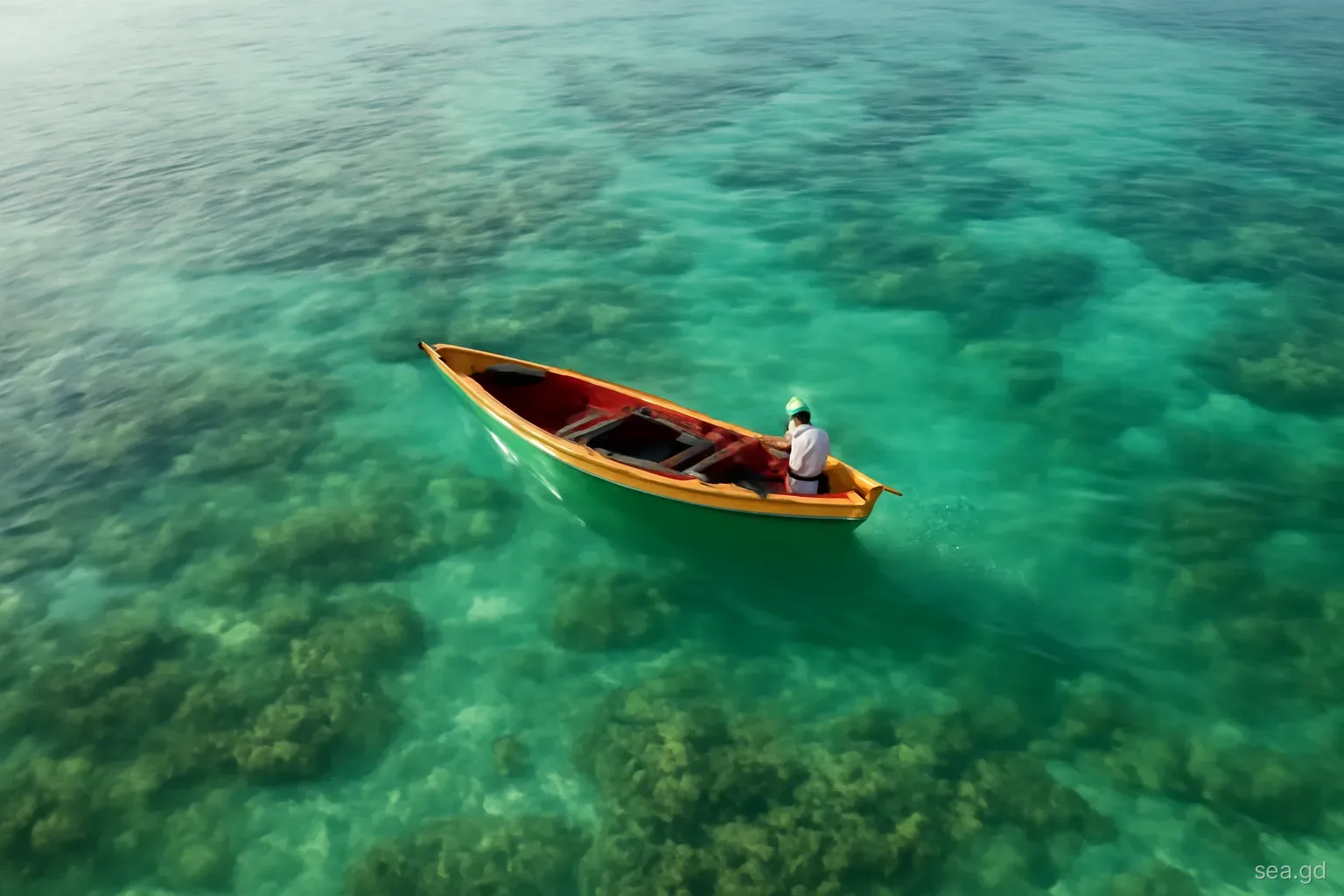
Most of what lives on Grenada's reefs is there all year. Parrotfish graze, hawksbills feed, dolphins pass and morays sit in their holes in January and in July alike. What changes with the seasons are the visitors, the breeding events and the conditions: humpback whales in the northern winter, leatherbacks on the Atlantic beaches through spring and summer, coral spawning on a few nights in late summer, and sargassum, warm water and storms in between.
This calendar sets out what tends to happen when. Nature does not keep strict dates, and a given year can run early or late, but the broad pattern is reliable enough to help you choose a month for a particular interest. Water temperatures and conditions are typical ranges, not guarantees.
January to March: whales, clear water and strong trades
The dry season is usually under way by January. The north-east trade winds blow steadily, rain is lighter, and runoff from the hills slows, which tends to mean the clearest water of the year on the west and south coasts. Water temperatures sit around 26 to 27 degrees Celsius, the coolest of the year, and a thin wetsuit is welcome on longer dives.
Humpback whales are in the Caribbean for their breeding season roughly from January to April. Grenada lies south of the main concentrations, but humpbacks are seen along the island chain in these months, so it is the best period for a chance sighting from a boat. Dolphins, pilot whales and sperm whales are possible at any time of year.
Pelagic fish such as dolphinfish, known in Grenada simply as dolphin or mahi, are more abundant offshore in the early months, which fishers and sport anglers know well. On the reef, several grouper species form spawning gatherings around the full moons of the winter months in parts of the Caribbean, which is one reason fisheries managers in the region protect these periods. The flip side of the trades is a choppier sea on exposed coasts and occasional northerly swell reaching the west coast.
March to June: the turtle season begins
Leatherback turtles start arriving on the Atlantic beaches, especially Levera in St Patrick, from around March, with peak nesting usually in April, May and June. Guided turtle watches run at night during this period, and it is the main window for anyone hoping to see a nesting leatherback. Hawksbills begin nesting later and continue well into the second half of the year.
Water warms gradually through this period, reaching around 27 to 28 degrees by June. The trades often ease in May and June, and the sea on the west coast can be glassy, which suits snorkelling and photography. This is also when the first sargassum may arrive. Since 2011 large rafts of this floating seaweed have reached the Caribbean in many years, mostly washing up on Atlantic-facing shores; the amount varies hugely from year to year.
Sea lice, the tiny larvae of certain jellyfish that cause an itchy rash under swimwear, are reported in the Caribbean mostly in spring and early summer. They are patchy and not a reason to stay out of the water, but rinsing off and changing out of a wet swimsuit promptly helps.
July to September: hatchlings, coral spawning and warm water
Leatherback hatchlings emerge from nests about two months after laying, so July and August are prime months for hatching on the Atlantic beaches, continuing into September. Hawksbill nesting continues on smaller beaches around Grenada and Carriacou.
The most remarkable event of the year happens on a handful of nights in late summer. Many Caribbean reef-building corals spawn in synchrony, releasing clouds of egg and sperm bundles a few nights after the full moon in August or September, usually a couple of hours after sunset. Predicting the exact night is difficult; some dive operators and researchers track it, and divers lucky enough to be in the water see the reef appear to snow upwards.
Water temperatures reach their annual high of around 28 to 29 degrees, sometimes more. In hot years this is when coral bleaching risk peaks, as happened across much of the Caribbean in 2023. It is also the core of the hurricane season and the rainy season, so visibility drops for a day or two after heavy rain and plans need flexibility. Between weather systems, seas on the west coast are often very calm.
October to December: the quiet shoulder
October remains warm and wet, with the hurricane season continuing to the end of November. Water stays around 28 degrees, and visibility depends heavily on recent rainfall. Bleached corals, if a hot summer caused bleaching, begin to recover or die back as temperatures fall. It is a good time for citizen-science reef surveys that record how corals came through the summer.
Hawksbill nesting tails off. Diving is quieter in terms of visitors, and on calm days the reefs are at their least crowded. December brings the start of the dry season and the return of steadier trade winds. Seabirds such as brown boobies and magnificent frigatebirds are present around offshore rocks and islets throughout the year, and some species nest on the small islands of the Grenadines at different seasons.
December is also when water starts to cool slightly again and the visiting season begins, bringing more boats to the popular sites. Divers who want quiet reefs can find them before mid-December.
Seasonal rules and harvests worth knowing
Some marine resources are managed with seasons, and these affect what you see in markets and on menus as much as underwater. Dates change, so confirm them with the Fisheries Division.
- Spiny lobster: Grenada has a closed season for lobster during part of the year, and egg-bearing females and undersized lobsters are protected at all times. Lobster on a menu in the closed season should raise a question.
- Sea turtles: nesting females and eggs are protected, and harvest of turtles has been tightly restricted. Avoid turtle meat and shell products entirely.
- White sea urchin (sea eggs): harvesting is limited to occasional open seasons set by the Fisheries Division, sometimes after several years of closure to let stocks recover.
- Queen conch (lambi): subject to size rules and regulated under international trade controls; buy only from reputable sources.
- Marine protected areas: fishing and collecting are prohibited or restricted all year in the reserves, regardless of species seasons.
Calendar mistakes that cost people the sighting
Booking a turtle trip for one night only. Leatherbacks do not nest every night on every stretch of beach. Allow two or three possible evenings in peak season, or accept that a single night may produce nothing.
Expecting whales on a short boat trip. Humpbacks are seasonal and never reliable off Grenada. A two-hour sunset cruise in February might see one; a dedicated morning offshore in calm conditions gives far better odds.
Treating coral spawning as a fixed date. Predicted nights are estimates based on the moon and water temperature. Coral sometimes spawns a night early or late, or splits across two months.
Ignoring the rain. Heavy overnight rain clouds the water near river mouths and in bays for a day or two. In the wet season keep a flexible day in your plans for the reef trip you care most about.
Assuming summer means hurricanes every week. Storms affect Grenada far less often than islands further north, and long calm stretches are normal. Watch forecasts and buy suitable travel insurance rather than ruling out the season.
Choosing your month by interest
For whales: January to April gives the best chance of humpbacks alongside year-round dolphins and pilot whales.
For nesting turtles: April to June for leatherbacks laying; July to September for hatchlings.
For the clearest water: the dry months from January to April usually offer the best visibility on the leeward coast.
For calm seas: May and June, and the quiet periods between weather systems in the summer and early autumn.
For coral spawning: late August and September, with flexible plans and a dive operator that tracks predicted nights.
For fewer boats: late spring and the autumn shoulder, outside the peak visitor weeks and cruise-ship days, when popular sites such as the sculpture park are noticeably quieter.
For seabirds and offshore life: any month, but calm days in the shoulder seasons make it easier to spot boobies and frigatebirds working schools of fish, which often also draws dolphins.
Frequently asked questions
What is the best month for marine life in Grenada?
There is no single best month. January to April offers whales and clear water, April to June offers nesting leatherbacks, and late summer offers hatchlings and coral spawning. Reef fish and turtles feeding on the reefs are present all year.
How warm is the sea in Grenada?
Water temperatures typically range from about 26 degrees Celsius in the cooler months of January to March to around 28 to 29 degrees in late summer and early autumn. A rash vest is enough for most snorkellers; divers often prefer a thin wetsuit.
When does sargassum arrive in Grenada?
Sargassum arrival varies greatly by year. Since 2011 it has reached the Caribbean in many years, mostly from spring through summer, and mainly affects Atlantic-facing beaches. The sheltered west and south coasts are usually much less affected.
Can you see coral spawning in Grenada?
Coral spawning happens on a few nights after the August or September full moon, a couple of hours after dark. It is unpredictable, and seeing it requires being on a night dive on the right evening. Ask local dive operators whether they track predicted spawning nights.
Does hurricane season affect marine life viewing?
Storms disrupt diving and can damage reefs, and heavy rain reduces visibility temporarily. Between systems, calm seas can make for excellent conditions. Most of the hurricane risk is concentrated from August to October, though Grenada is hit less often than islands further north.