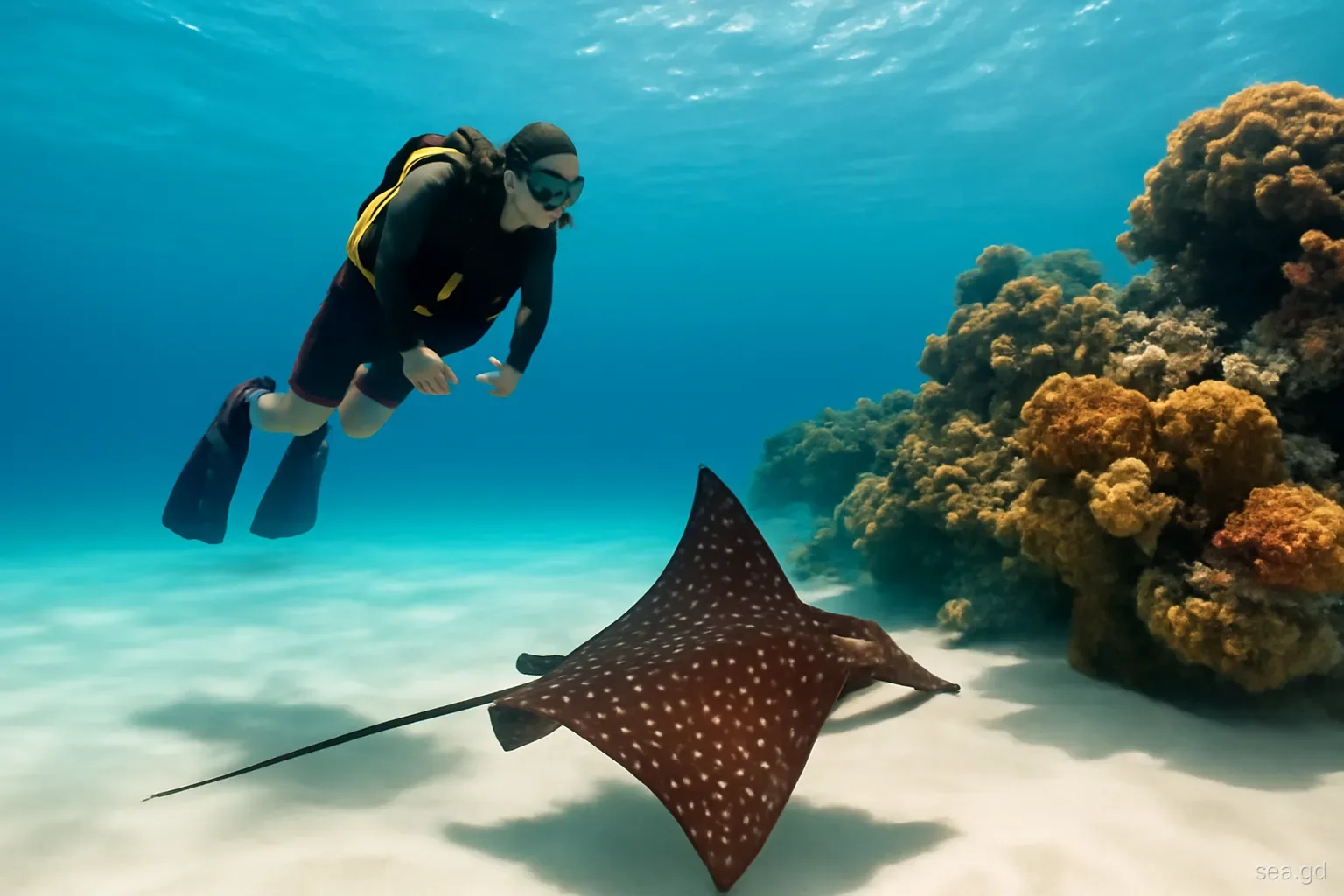
For many first-time divers the question is not whether Grenada's reefs are pretty but whether anything down there is big enough to worry about. The honest answer is that sharks, rays and eels are all part of a dive here, and none of them is interested in people who behave sensibly. A nurse shark asleep under a ledge, an eagle ray flying past along the drop-off or a green moray yawning from its hole are the highlights of a dive, not a risk.
This page covers the larger animals you are most likely to see, how to recognise each, what their behaviour means and the handful of situations where caution is genuinely needed. It complements, rather than repeats, beach first-aid advice on stingray stings; the focus here is on seeing these animals in the water and understanding them.
Sharks you might see
Nurse shark. The shark most divers in Grenada meet. Brown to tan, with a broad flat head, two barbels at the nostrils, a small mouth and two dorsal fins set far back. Nurse sharks spend the day resting on the sand or wedged under ledges, sometimes several together, and hunt at night by sucking crustaceans, octopus and small fish out of crevices. They are placid, but a nurse shark grabbed by the tail can bite and hold on, which is the cause of most minor shark bites in the Caribbean. Look and leave it alone.
Caribbean reef shark. Grey, streamlined, and the classic shark shape. Reef sharks are seen more often on deeper sites, wrecks and current-swept reefs, including around Carriacou and the islets to the north, than on shallow snorkelling reefs. They usually circle at a distance, take a look and move on.
Blacktip and others. Blacktip sharks occasionally pass through shallow water, and hammerheads, silky sharks and even whale sharks have been reported offshore. These are rare sightings for most divers and are usually brief.
Rays: from the sand to the open water
Southern stingrays are the commonest ray on the sandy patches around Grenada's reefs and in bays. They are diamond-shaped, grey-brown above and white below, and often lie buried under a thin layer of sand with only the eyes and spiracles showing. Watch long enough and you may see one feeding, flapping its wings to blast sand out of the bottom and expose buried prey; bar jacks and other fish often hang above it to grab what is disturbed. The barbed spine at the base of the tail is purely defensive and is used when a ray is stepped on or pinned.
Yellow stingrays are small, round and covered in fine yellow-and-brown speckles that change to match the bottom. They are easy to overlook and are a good find for patient snorkellers.
Spotted eagle rays are the rays divers remember. Dark above with white spots or rings, a white belly, a pointed duck-like snout and a very long thin tail, they fly through the water with slow wing beats, singly, in pairs or in small groups. They are often seen along reef edges and over sand slopes, sometimes digging for clams and conch. Manta rays are occasional visitors, more likely on current-swept sites and in plankton-rich water; any sighting is a stroke of luck.
Moray eels and their relatives
Green moray. The largest moray in the Caribbean, growing beyond two metres. The green colour comes from a yellowish mucus over a dark blue skin. Green morays often lie half out of a hole in daylight on Grenadian reefs and wrecks.
Spotted moray. Smaller, pale with dense dark spots, and very common in reef crevices. It is the moray most snorkellers notice, often with only its head showing.
Goldentail and chain morays. The goldentail is dark brown with fine golden flecks; the chain moray has a striking black-and-yellow chain pattern. Both prefer shallow rocky areas and reef tops.
Sharptail eel and snake eels. Not all eels live in holes. The sharptail eel forages openly across the reef at times, and snake eels may poke only their heads out of the sand, which surprises people expecting a fish.
Why morays gape. A moray opening and closing its mouth is breathing, pumping water over its gills. It is not a threat display. Morays bite when a hand goes into their hole or when they have been fed by hand and associate fingers with food.
Understanding behaviour: what is normal and what is a warning
Most interactions with these animals follow predictable patterns. Nurse sharks and stingrays rest during the day and rarely move unless disturbed. Reef sharks investigate and then lose interest. Eagle rays keep their distance and turn away if chased. Morays stay in their holes. If you hover calmly, breathe slowly and do not pursue anything, you will usually get longer, closer views than if you swim towards the animal.
Signs that you are too close are worth knowing. A shark that drops its pectoral fins, arches its back and swims in a stiff, jerky way is uncomfortable, and the right response is to move calmly away, facing it. A ray that lifts off the sand and flaps hard is fleeing. A moray that pulls back and opens wide has felt threatened. In all cases, giving space ends the situation.
Many of the animals here also visit cleaning stations, where small gobies and shrimps pick parasites from their skin and mouths. A moray with its mouth wide open and a shrimp inside, or a grouper hanging motionless with fins flared, is being cleaned. Watching from a short distance without interrupting is one of the best behaviour sights on any dive.
Where and when to look for them
Each of these animals has a favourite kind of place, and searching the right habitat matters more than covering distance. Nurse sharks and spotted morays favour reefs with plenty of overhangs, crevices and broken structure, which is why wrecks and rocky reef walls produce more of them than flat coral gardens. Look under ledges and into the dark spaces at the base of coral heads, using a torch on a dive even in daylight.
Stingrays and eagle rays need sand. The edges where reef meets sand, the sand channels running between coral fingers, and the sandy floors of sheltered bays are where to find rays resting or feeding. Eagle rays also cruise along drop-offs and through areas of moderate current, so they turn up more on drift dives than on a calm shallow reef.
Reef sharks and the occasional big pelagic visitor are associated with deeper water and current, which in Grenada means the outer sites, the wrecks lying in open water and the passages between Carriacou and its offshore islets. Early morning dives and the last light of the afternoon are often livelier for predators than the middle of the day. Night dives give the best chance of seeing nurse sharks and morays out hunting rather than resting.
Practical cautions for snorkellers and divers
Real injuries from these animals in Grenada are uncommon and almost always come from contact. A few habits prevent nearly all of them.
- Shuffle your feet when wading over sandy bottoms in bays, so that any buried ray feels you coming and moves off.
- Never grab, ride or pull the tail of a nurse shark, however docile it looks.
- Keep hands out of holes and crevices and do not put fingers near a moray's head, even for a photo.
- Do not feed sharks, rays or eels. Hand-feeding has created bold, pushy animals at some Caribbean sites and has led to bites.
- Avoid shiny jewellery and watches that flash in the water and can attract curious fish.
- If you are stung by a ray, get out of the water and seek medical help; hot water as hot as the casualty can tolerate is the usual first step for pain, and the wound needs cleaning by a professional. In an emergency call 911.
- Report entangled or injured sharks and rays to the Fisheries Division rather than trying to free large animals yourself.
Frequently asked questions
Are there dangerous sharks in Grenada?
Unprovoked shark bites in Grenada are extremely rare. Most divers see only nurse sharks and occasional Caribbean reef sharks, neither of which shows interest in people who leave them alone. Larger species are rare offshore visitors.
Where can you see eagle rays in Grenada?
Spotted eagle rays are seen on many reefs and sand slopes around the main island and Carriacou, often along drop-offs and in areas with some current. Sightings are never guaranteed, but dive guides usually know where they have been seen recently.
Is it safe to snorkel near stingrays?
Yes, as long as you look rather than touch. Stingrays only use their spine when stepped on or pinned. Snorkelling above them is safe; wading barefoot over sand without shuffling is the risky part.
Do moray eels attack divers?
Morays do not hunt people. Bites happen when a hand enters their hole or when an eel has been conditioned by hand-feeding to expect food. Keep your distance, keep your hands to yourself and enjoy watching them breathe.
Can you see manta rays in Grenada?
Manta rays are occasional visitors rather than residents. They are more likely on current-swept sites and in plankton-rich water. Treat any sighting as a lucky bonus rather than something to plan a trip around.