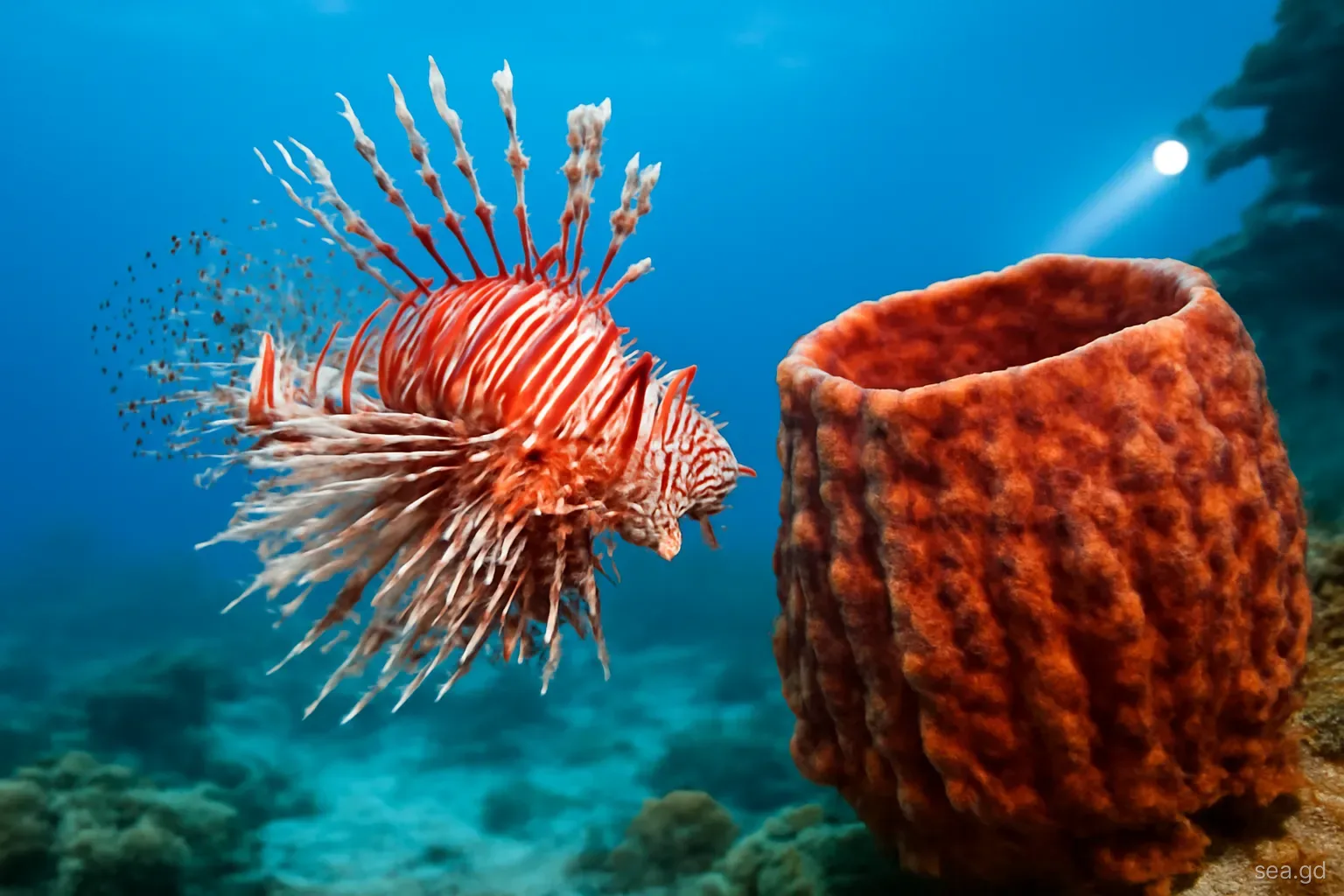
The lionfish is the most beautiful problem on Grenada's reefs. Banded in red and white, fanned out with long feathery spines, it hangs almost motionless under ledges and photographs wonderfully. It also has no business being here. Lionfish come from the Indian and Pacific Oceans, and in the Atlantic and Caribbean they are an invasive predator that eats young reef fish faster than reefs can replace them.
They arrived in Grenadian waters around the turn of the 2010s, at the southern end of an invasion that began off Florida decades earlier. Since then dive operators, fishers, the Fisheries Division and restaurants have all had a part in keeping numbers down. This page explains what the fish is, why it matters, how culling works, what to do if you are stung, and why ordering it for dinner is one of the more useful things a visitor can do for the reef.
Where lionfish came from and how they reached Grenada
Two closely related species are involved, the red lionfish and the devil firefish, and they are almost impossible to tell apart underwater. Both were popular aquarium fish in the United States. Lionfish were first reported off south Florida in the 1980s, and by the early 2000s they had established breeding populations along the south-east US coast and in the Bahamas. From there larvae drifting on currents carried them through the Caribbean at remarkable speed.
By the late 2000s lionfish were turning up across the Greater Antilles and the western Caribbean, and they spread down the Lesser Antilles to the southern Caribbean within a few years. Grenada's first sightings date from around 2010 to 2011, and within a short time they were present on reefs and wrecks around the main island and Carriacou, from shallow sea-grass edges to deep wreck dives.
The speed of the invasion is explained by their biology. A female can spawn every few days through the year, releasing floating egg masses that hatch into larvae that drift for weeks. In their new range adults have few effective predators, they tolerate a wide range of depths and habitats, and they eat almost any small fish or crustacean that fits in their mouth.
Why lionfish are bad news for the reef
They eat the next generation. Lionfish target small fish, including juvenile parrotfish, wrasses, damsels, groupers and snappers. Studies elsewhere in the Caribbean have recorded sharp drops in small native fish on reefs where lionfish densities were high.
They hit the algae grazers. Parrotfish and surgeonfish keep seaweed in check. Remove their young and algae can smother corals that are already stressed by heat and disease, which tips a reef towards a weedier state.
Native fish do not recognise them. Lionfish hunt by slowly cornering prey with their outspread fins and swallowing it in one rapid gulp. Caribbean fish have no evolutionary experience of this hunting style, so they often fail to flee.
Few things eat them. Large groupers and some sharks can eat lionfish, but those predators are scarce on fished reefs. Human removal is, for now, the main control.
They live beyond diving depth. Lionfish have been recorded on reefs far deeper than recreational divers go, down to depths of more than a hundred metres in the region. Those deep populations act as a reservoir that keeps resupplying the shallow reefs with larvae, so culling the shallows has to be repeated.
They compete with fisheries. The young fish lionfish eat include commercially important species, so the impact reaches fishers' catches as well as divers' views.
How culling works in Grenada
Complete eradication is not realistic; the goal is to keep numbers low on the reefs people use and value. In Grenada removal has been carried out mainly by trained divers working with dive operators and with the knowledge of the Fisheries Division, using small pole spears or nets and puncture-proof containers designed to hold the catch without being stung. Regular culling on popular dive sites has kept densities there well below their peak.
Spearfishing is tightly regulated in Grenada, and taking fish of any kind inside marine protected areas is prohibited without authorisation. Visitors should not bring a spear and start culling on their own initiative. If you are an experienced diver interested in helping, ask a dive shop whether it runs lionfish dives or training and what permission covers them. Some operators offer specialty courses that teach safe handling and removal.
Divers who are not culling still help by reporting sightings. Tell the guide on the boat where you saw a lionfish, its depth and roughly how big it was. Guides often keep track of individuals and return to remove them.
If you are stung: first aid
Lionfish venom sits in grooves along the dorsal, pelvic and anal spines. Stings happen when people handle the fish, brush against it under a ledge or clean a caught fish carelessly. They are very painful but rarely life-threatening for healthy adults.
- Get out of the water and check for signs of a severe reaction such as difficulty breathing, chest pain, fainting or swelling of the face. If any of these appear, call 911 or get to the nearest hospital immediately.
- Remove any visible pieces of spine carefully, without squeezing the wound.
- Immerse the stung area in hot water, as hot as the person can tolerate without scalding, for thirty to ninety minutes. The venom is broken down by heat and the pain usually eases noticeably. Test the water temperature on unaffected skin first, because the stung area may be numb.
- Clean the wound thoroughly with soap and fresh water and cover it.
- See a doctor, especially for deep punctures, a sting on a child, persistent swelling or any sign of infection in the following days. Tell them it was a lionfish sting.
Eating lionfish: the tastiest form of control
Lionfish are only venomous, not poisonous. The venom lives in the spines; the flesh is firm, white and mild, closer to snapper or grouper than to anything unusual. Once the spines are trimmed off with scissors, preferably by someone with experience, the fish is filleted like any other. Cooked properly, there is no venom risk.
Some Grenadian restaurants and fish vendors offer lionfish when supply allows, as ceviche, fried whole, in fish tacos or simply grilled, and asking for it helps create a market that pays divers and fishers to remove more. Supply depends on culling and catch, so it is not always on the menu.
One caution applies across the Caribbean: ciguatera, the toxin that can build up in reef predators, has been detected in lionfish in some areas, as it has in barracuda and large jacks. Local knowledge of where fish are caught matters, which is another reason to buy from established vendors rather than from unknown sources.
Mistakes to avoid around lionfish
Lionfish are slow and appear calm, which leads people to underestimate them.
- Do not touch, poke or try to move a lionfish for a better photo; they turn their spines towards a threat.
- Watch where you put hands and knees under ledges and inside wrecks, where lionfish shelter by day.
- Do not pick up a lionfish that a culler has speared, even if it looks dead; the spines remain venomous after death.
- Do not cull inside a protected area or with a spear you brought yourself without checking the rules first.
- Do not assume a striped fish is a lionfish; juvenile native species and scorpionfish can be confused with it, and scorpionfish are also venomous.
- Do not clean a whole lionfish at home without gloves and sharp scissors; trim every spine first and dispose of them where nobody will step on them.
- Do not feed speared lionfish to sharks or morays. Some divers once did this hoping to teach predators to hunt them, but it mainly trained the predators to follow divers and pester them for food.
Frequently asked questions
Are lionfish native to Grenada?
No. Lionfish are native to the Indo-Pacific. They were introduced to the western Atlantic, probably through the aquarium trade, and spread through the Caribbean, reaching Grenada around 2010 to 2011.
Can a lionfish sting kill you?
Deaths are extremely rare. Stings are intensely painful and can cause swelling, nausea and dizziness. People with allergies, heart conditions or a severe reaction need urgent medical help; call 911 if breathing becomes difficult.
Is lionfish safe to eat?
Yes. The venom is in the spines, not the meat, and cooking removes any residual risk from handling. As with other reef predators, ciguatera has occasionally been reported in some regions, so buy from reputable sources.
Can visitors help cull lionfish in Grenada?
Experienced divers may be able to join supervised culling through a dive operator that runs lionfish dives or specialty training. Do not cull independently: spearfishing is restricted and prohibited in protected areas without authorisation.
Where do lionfish hide on the reef?
By day they rest under ledges, in crevices, inside wrecks and around large sponges and coral heads, often upside down under overhangs. They become more active at dusk and night, when they hunt small fish in the open.
Have culling efforts worked?
Regular culling keeps numbers low on the dive sites where it happens, and native fish benefit locally. Lionfish remain widespread on deeper and less visited reefs, so control is ongoing rather than finished.