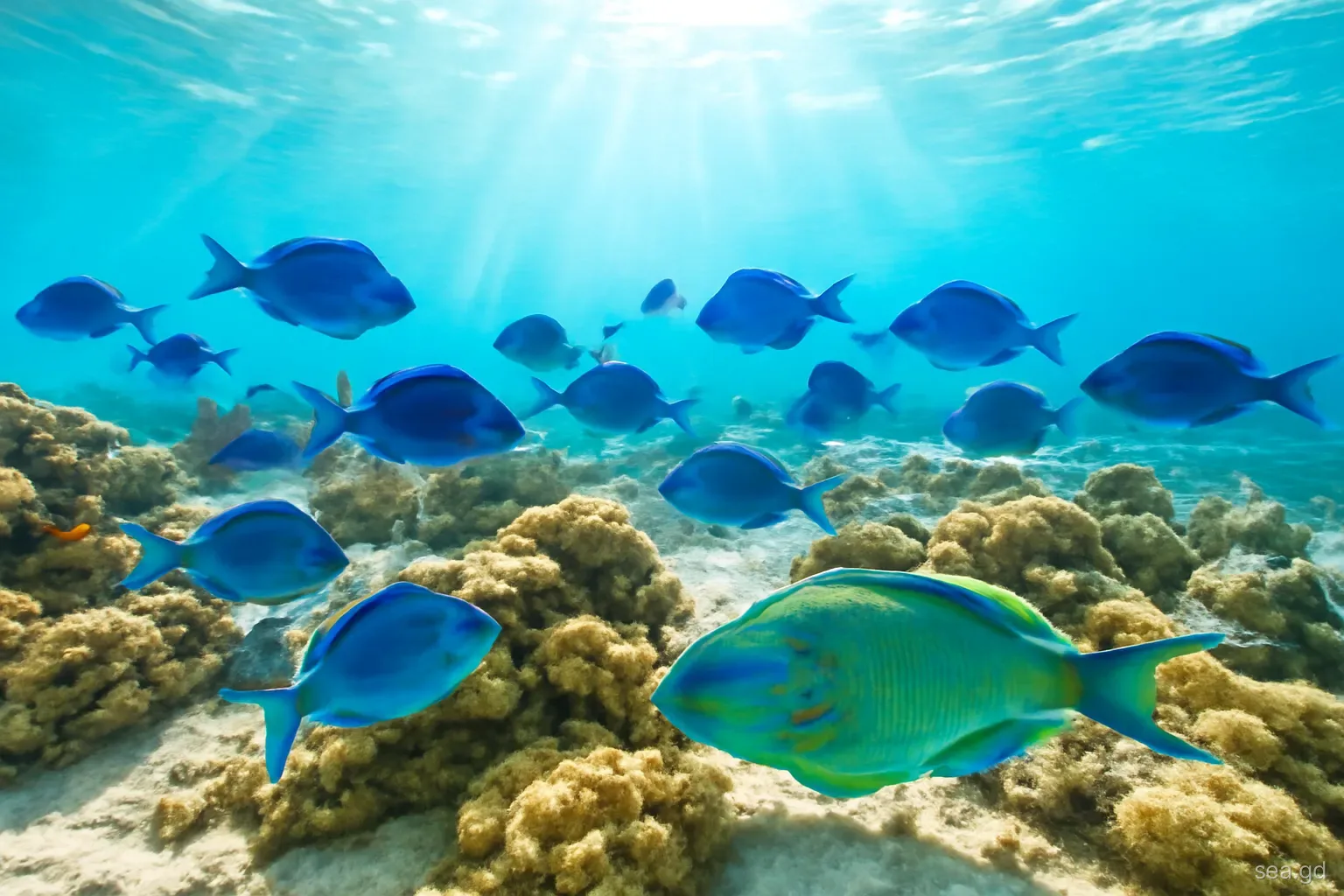
Put your face in the water at almost any reef off Grenada's south or west coast and within a minute you will see the same twenty or so species: stripy sergeant majors, schools of blue tang, parrotfish crunching at the rock, a trumpetfish hanging head-down beside a sea rod. Grenada's reefs belong to the wider Caribbean fauna, so a good Caribbean fish guide covers nearly everything, but knowing which fish turn up first saves a lot of page-flipping on the boat afterwards.
The trick to identification is not colour. Many reef fish change colour as they grow, switch sex, or fade and darken in seconds. Body shape, the way a fish swims and where it spends its time are far more reliable. This page groups the commonest species by family, explains the behaviour that gives each away, and lists the confusions that catch out new snorkellers and divers.
Grazers: parrotfish, surgeonfish and tangs
Parrotfish. Heavy-bodied fish with fused, beak-like teeth, swimming by rowing with their pectoral fins rather than flicking the tail. You hear them before you see them: a steady crunching as they scrape algae from dead coral. The stoplight parrotfish is the commonest large one, and its two phases look like different species: the initial phase is mottled brown and white with a red belly, the terminal male is green with a yellow spot near the gill cover and at the base of the tail. Queen, princess and redband parrotfish are also frequent. The fine white sand of many Grenadian beaches is partly their work, ground coral passed through the gut.
Blue tang. Oval, flat and usually in loose schools that sweep across the reef top grazing as they go. Adults are powder blue to deep purple; juveniles are bright yellow, which fools many people into thinking they are a separate fish. Like all surgeonfish they carry a sharp, scalpel-like spine at the base of the tail, so never grab one.
Ocean surgeonfish and doctorfish. Same shape as the tang but grey-brown to blue-grey. Doctorfish show faint vertical bars; ocean surgeonfish have a crescent tail with long tips. They often mix into blue tang schools, and a mixed school of fifty or more is a normal sight on a shallow reef flat.
Damselfish: small, bold and territorial
Sergeant major. The fish nearly everyone notices first: five black vertical bars on a pale body with a yellow back. They gather in the water column near moorings and pilings and come straight to snorkellers, mostly because people have fed them in the past. In the nesting season males guard purple egg patches on rock and turn a darker blue-grey.
Yellowtail damselfish. As an adult a plain dark blue fish with a yellow tail. The juvenile, often called the jewel damsel, is deep blue scattered with electric-blue spots and is one of the prettiest small fish on the reef. It hides among branching coral and fire coral.
Threespot and dusky damselfish. Drab brown fish that farm small patches of algae on dead coral and defend them with surprising aggression. If a five-centimetre fish nips at your mask or your ankle on a dive, it is almost certainly one of these. They are harmless and simply telling you to move on.
Chromis. Blue chromis and brown chromis hover in loose clouds above the reef, picking plankton from the current. Their constant movement over a coral head is a useful sign of good water flow and a healthy patch of reef.
Angelfish, butterflyfish and wrasses
Angelfish and butterflyfish are the disc-shaped fish that photographers chase. French angelfish are black with each scale rimmed in yellow, usually in pairs, and are curious enough to approach a diver who stays still. Grey angelfish are similar in shape but plain grey with a pale mouth. The queen angelfish, blue and yellow with a dark crown spot on the forehead ringed in electric blue, is the one people most want to see; it is regular in Grenada but less common than the French. The rock beauty, yellow at both ends with a black middle, is a smaller relative that feeds on sponges.
Butterflyfish are smaller and more delicate. The foureye butterflyfish has a false eye-spot near the tail and a dark bar through its real eye, a classic defence that makes predators strike at the wrong end. Banded butterflyfish wear two thick black bars, and spotfin butterflyfish show a dark spot on the rear fin. Most travel in pairs and stay together for long periods.
Wrasses are slim, fast and everywhere. The bluehead wrasse illustrates how confusing colour can be: most are small yellow fish, sometimes with a dark stripe, but the dominant terminal males have a blue head, black and white collar bands and a green body. Creole wrasse form purple schools in mid-water, and a well-known Grenadian dive site takes its name from the effect. The Spanish hogfish, purple above and yellow below, and the larger hogfish with its long snout and trailing dorsal spines, are also wrasses.
Ambushers, hiders and odd shapes
Some of the most memorable fish on a Grenadian reef do not swim around in the open at all. Learn these shapes and behaviours and you will find far more of them.
- Trumpetfish: long, stick-like body, often hanging vertically among sea rods or sea fans so it blends in. It also shadows larger fish to sneak up on prey, so look along the back of a grouper or parrotfish.
- Squirrelfish and soldierfish: red fish with large eyes, hiding under ledges by day and hunting at night. Squirrelfish have a long rear dorsal fin; soldierfish are rounder and blunter.
- Trunkfish and cowfish: boxy bodies enclosed in bony plates, swimming with a hovering motion. The smooth trunkfish is dark with white spots; the honeycomb cowfish has two small horns and a net pattern.
- Pufferfish and porcupinefish: slow swimmers with big eyes that inflate when threatened. Do not provoke them into doing it; it stresses the fish and can kill it.
- Goatfish: yellow or spotted fish working the sand with a pair of barbels under the chin, usually followed by opportunists such as bar jacks hoping to catch what they flush out.
- Yellowhead jawfish and garden eels: sand-slope dwellers that hover above or poke out of burrows and vanish if you approach quickly. Male jawfish brood eggs in their mouths.
- Peacock flounder: a flatfish covered in blue rings, lying on sand and changing its colour to match the bottom; you usually spot it when it moves.
Bigger fish: snappers, grunts, groupers and barracuda
Under ledges and around coral heads you will see schools of grunts by day, mostly French grunts with yellow diagonal stripes and bluestriped grunts with blue lines on yellow. They rest in groups in daylight and spread out over seagrass to feed at night. Yellowtail snapper, silvery with a bright yellow stripe running into a forked yellow tail, follow divers and boats; mahogany and schoolmaster snapper are also common.
Groupers on Grenada's reefs are mostly small species: the coney and the graysby, both covered in fine spots, and the red hind. Large groupers are scarce across much of the Caribbean because they have been heavily fished for decades, so a big one is a notable sighting and a sign that protection is working where you saw it.
Great barracuda hang motionless near the surface or just off the reef, sometimes following snorkellers out of curiosity. Their teeth look alarming but incidents with people in clear water are extremely rare; avoid wearing shiny jewellery and do not try to feed them. Large barracuda are also a known source of ciguatera if eaten, which is why many local fishers avoid selling big ones.
Mistakes that make identification harder
Relying on colour alone. Juveniles, initial-phase fish and terminal males can look like three different species. Note shape, fin outline and behaviour, then check colour last.
Chasing the fish. A fish pursued by a snorkeller flees and you see only its tail. Hover still near a coral head for two minutes and the residents come back out, often closer than before.
Ignoring the sand and the ledges. Many species live on the sand edges or under overhangs. Swim slowly along the reef margin and look down and under, not just across the reef top.
Touching or feeding. Feeding concentrates aggressive species such as sergeant majors and changes behaviour on the whole reef. Inside the marine protected areas it is also against the rules.
No record of what you saw. An underwater slate, or a few quick notes on the boat, combined with a regional field guide such as the widely used Humann and DeLoach reef fish book, makes the names stick far better than memory alone.
Frequently asked questions
What is the most common fish on Grenada's reefs?
On shallow reefs the sergeant major, blue tang, various parrotfish, bluehead wrasse and brown chromis are among the most frequently seen. Which one dominates depends on depth and habitat, but these turn up on almost every snorkel off the south and west coasts.
Are any reef fish in Grenada dangerous to snorkellers?
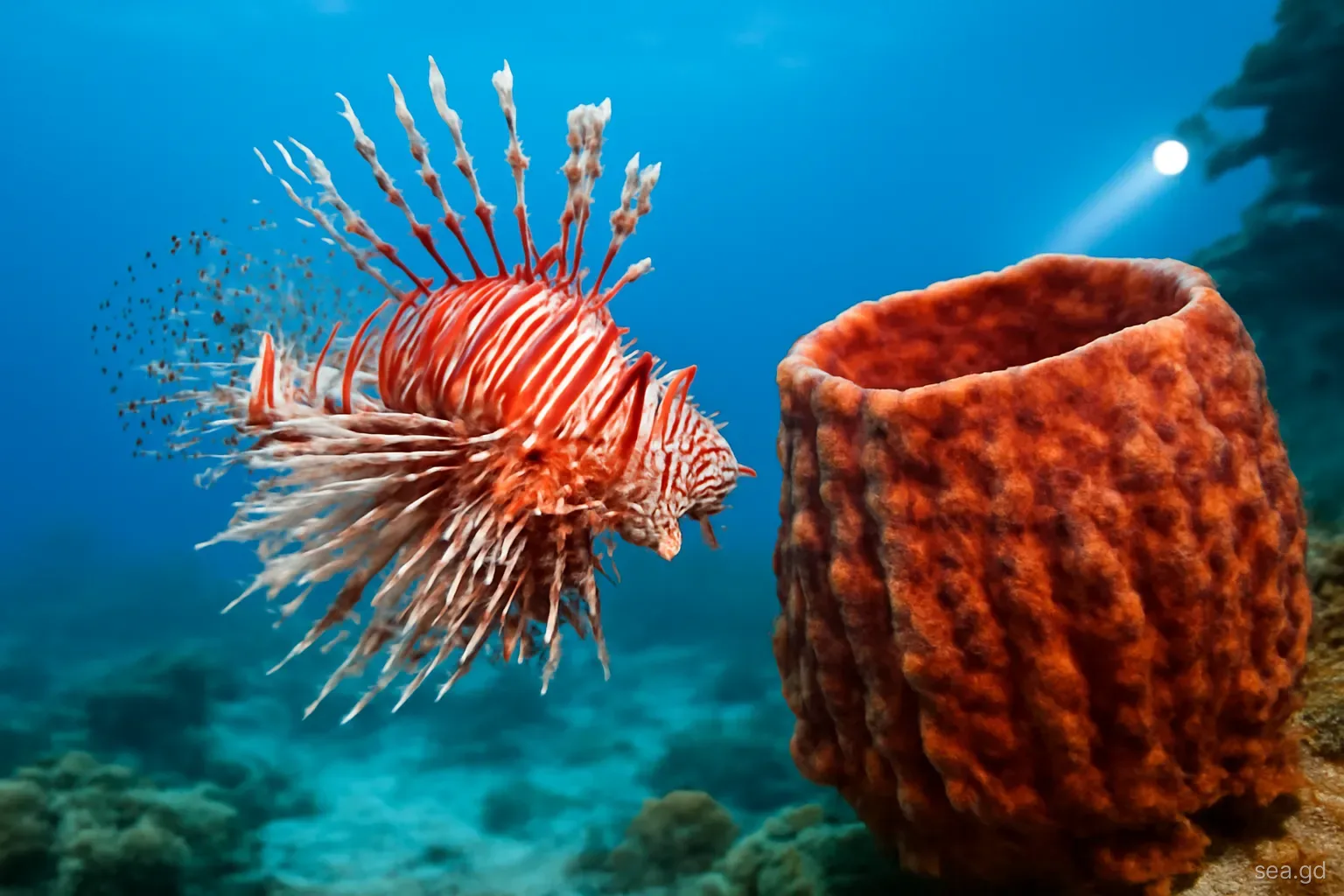
Very few. Lionfish and scorpionfish have venomous spines, surgeonfish carry a tail scalpel, and morays bite if hands go into holes. Barracuda are curious but rarely a problem. Look, do not touch, and keep your hands out of crevices.
Why do some reef fish change colour so quickly?
Many reef fish control pigment cells in their skin and can darken, pale or show bars within seconds, for camouflage, when stressed, during courtship or at cleaning stations. Some species also change colour permanently as they mature or change sex.
Is there a good book for identifying Caribbean fish?
The Humann and DeLoach reef fish identification guide for Florida, the Caribbean and the Bahamas is widely used by dive shops and naturalists. Waterproof fish ID cards sold at dive shops are a handy, cheaper option for snorkellers.
Can you see seahorses or frogfish in Grenada?
Yes, both occur, but they are small, well camouflaged and usually found by experienced guides who know where individuals have been living. Ask a dive shop if they have had recent sightings rather than expecting to find them alone.
Do fish behave differently in the marine protected areas?
Often yes. Where fishing is restricted, fish tend to be larger, more numerous and less wary of divers. Groupers and snappers in particular are easier to approach on protected reefs than on heavily fished ones.