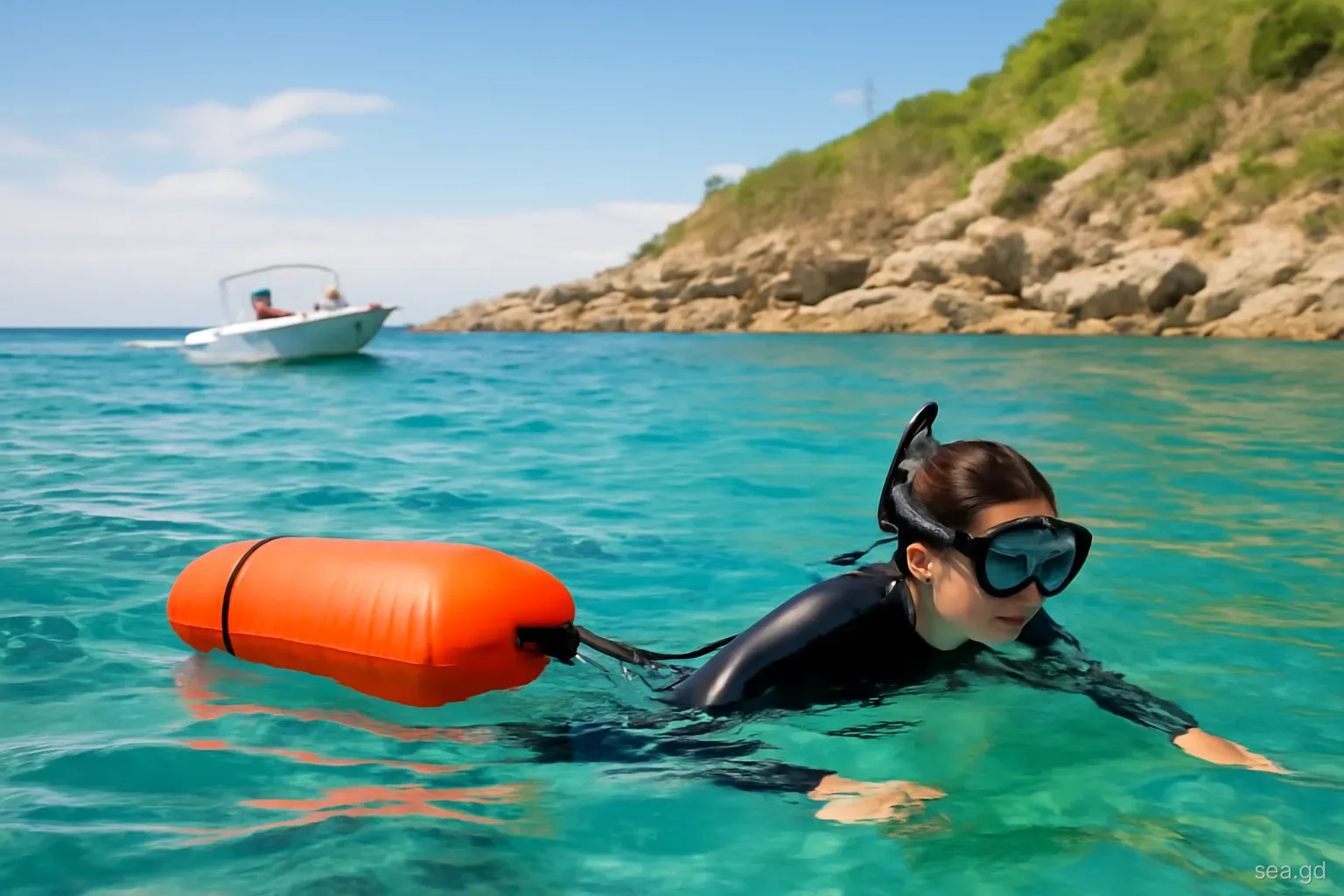
Most serious snorkelling incidents in the Caribbean have little to do with sharks, jellyfish or coral cuts. They involve tired swimmers far from shore, snorkellers hit by boats they never saw, and older visitors whose hearts struggle with exertion in warm water. Grenada's calm leeward bays make snorkelling feel effortless, which is part of the risk: it is easy to drift farther and stay longer than your body or the conditions allow.
None of this means snorkelling is dangerous when done sensibly. It means the precautions that matter most are unglamorous: being visible, knowing which way the water is moving, keeping something in reserve for the swim back, and being honest about health. This page sets out those priorities in order, then covers the marine life worth respecting and what to do if something goes wrong.
Boats: the hazard snorkellers underestimate
From the surface, a snorkeller is a small dark shape barely breaking the water. From the helm of a fast water taxi with the sun in the driver's eyes, that shape is close to invisible. Around Grenada, the busiest waters for small craft are exactly where people like to snorkel: along Grand Anse, around Quarantine Point, in the bays north of St George's where tour and dive boats come and go, and near yacht anchorages on the south coast and in Carriacou.
The defences are simple. Stay inside buoyed swimming areas where they exist. Away from them, tow a brightly coloured inflatable buoy or wear a fluorescent swim cap, and lift your head to look around every minute or two. Stay close to the shoreline rather than crossing open water between bays, and never snorkel in channels where boats enter and leave a bay or marina.
If you hear an engine getting louder, stop, raise your head and an arm, and move toward the shore or the rocks. Boat drivers who see you will slow down, but you should never assume they have. When snorkelling from a boat, stay on the side the crew points out and away from the stern and propeller, and do not swim under the boat or its mooring line.
Jet skis deserve particular caution on the south-west beaches. They are fast, manoeuvrable and sometimes ridden by visitors with little experience, and a rider looking back at a passenger is not looking for heads in the water. If personal watercraft are operating off a beach, keep your snorkel close to the sand or move to a quieter bay.
Currents and the swim back
Snorkel up-current first. Before you start, watch which way floating debris, bubbles or anchored boats' sterns are moving. Swim into the current at the beginning of the snorkel, when you are fresh, so that the return is easier. Many people do the opposite without realising it, drifting effortlessly along a reef and then facing a hard swim back.
Watch the points. Currents strengthen around headlands such as Quarantine Point, Molinière Point and the tip of Point Salines, and between islets in Carriacou. A calm bay can have a brisk current running across its mouth.
Use the rule of thirds. Borrowed from scuba, the idea is to turn around while you still have at least two-thirds of your energy. Snorkellers rarely feel tired until they stop admiring the reef and start swimming against the water.
If you are being carried away. Do not fight the current head-on. Swim across it, parallel to the shore, until you are out of it, then head in. Float on your back to rest if needed, and raise an arm to signal for help.
Keep fins on. Fins are what give a snorkeller the power to deal with a current. Taking them off to walk over rocks and then being swept off your feet in surge is a common way to get hurt.
Health: the risk nobody mentions on the boat
Medical researchers studying snorkelling deaths in tropical destinations have found that a large share involve middle-aged and older visitors, often with no obvious problem in the water beforehand. Cardiac events and immersion pulmonary oedema, a condition in which fluid builds up in the lungs during swimming, are thought to explain many of them. Exertion, warm water, anxiety and breathing through a tube all add load on the heart and lungs.
Practical conclusions follow. If you have heart disease, high blood pressure, a lung condition or simply have not exercised in a while, talk to a doctor before a snorkelling holiday. Wear a snorkel vest even if you swim well, because it lets you rest at the surface without effort. Take a few minutes to float and breathe calmly before you start swimming. And if you feel breathless, have chest discomfort or start coughing frothy fluid, stop, signal, and get out of the water; do not try to push on.
Alcohol deserves its own line. Catamaran trips commonly serve rum punch, and the safest order is snorkel first, drink afterwards. Dehydration and sunburn also creep up on people floating for an hour in tropical sun, so drink water before and after each session.
Children need their own rules. They tire suddenly, chill faster than adults and can swallow water when a small wave washes over the snorkel. Keep them within arm's reach in deeper water, use a properly sized vest rather than an adult one cinched tight, and keep sessions short enough that they finish wanting more. An adult whose only job is to watch the children, rather than the reef, is the best safety device a family can bring.
Marine life worth respecting
Grenada's reefs have no animals that hunt snorkellers, but a few deserve caution. Almost all injuries come from touching, stepping on or cornering something:
- Sea urchins: black long-spined urchins cluster in rocky shallows; spines break off in skin. Enter from sand where possible and wear water shoes over rocks.
- Fire coral: mustard-coloured branching or encrusting growths that sting on contact. Keep hands and fins off all coral, which protects both you and the reef.
- Lionfish: an invasive species that reached Grenada around 2011. They are slow and approachable, but their spines are venomous. Admire them without touching.
- Barracuda: curious and often follow snorkellers at a distance. Attacks are extremely rare; removing shiny jewellery and avoiding splashing around them reduces interest further.
- Jellyfish and stinging plankton: occasional, and seasonal. A thin rash guard reduces stings; vinegar is commonly used on box jellyfish stings, but advice varies by species.
- Moray eels: they open and close their mouths to breathe, which looks threatening. They bite only if a hand goes into their hole.
If something goes wrong
A little preparation turns a frightening moment into a manageable one. Before any independent snorkel, run through this checklist with your companion:
- Tell someone ashore where you are going and when you expect to be back.
- Agree simple signals: a hand on the head for "all fine" and a waved arm for "help needed".
- If a companion is in trouble, keep their face out of the water, call loudly for help, and tow them toward shore or a boat; do not let them climb on top of you.
- Once on land, call 911 for an ambulance or police; the Grenada Coast Guard responds to incidents at sea. Know the name of the beach or bay you are at, since rural spots have no street addresses.
- For an unconscious snorkeller who is not breathing, start rescue breaths and CPR while someone else calls for help.
- The main hospital on the island is the General Hospital in St George's; on Carriacou, check what medical services are operating after Hurricane Beryl before you travel.
- Carry travel insurance that covers water activities and, ideally, medical evacuation.
Frequently asked questions
Is it safe to snorkel alone in Grenada?
It is not recommended. A companion can help with cramps, currents, exhaustion or a medical problem, and two people are easier for boat drivers to spot. If you must snorkel alone, stay close to shore in a calm, buoyed area, tow a bright buoy and tell someone exactly where you are and when you will return.
Are there sharks when snorkelling in Grenada?
Sharks live in Grenada's waters, as in all tropical seas, but snorkellers in shallow bays rarely see them. Nurse sharks resting under ledges are the species most commonly encountered, mostly by divers, and are docile unless provoked. Shark incidents involving snorkellers in Grenada are extremely rare.
Should older visitors avoid snorkelling?
Not necessarily, but they should be realistic. Older snorkellers and anyone with heart, blood pressure or lung conditions should get medical advice first, wear a flotation vest, start slowly, avoid exertion against currents and get out promptly if they feel breathless or unwell. Guided trips with attentive crews add a margin of safety.
What number do you call for an emergency in Grenada?
Dial 911 for police, fire or ambulance. The Grenada Coast Guard handles incidents at sea, and emergency services can relay a call to them. Give the name of the beach or bay and a nearby landmark, because many coastal spots lack formal addresses.
Do snorkel tours provide life jackets?
Most reputable operators carry flotation vests or snorkel vests and will offer them, often recommending them for less confident swimmers. If having one matters to you, ask when booking. A vest does not stop you seeing the reef; it simply lets you rest at the surface without effort.