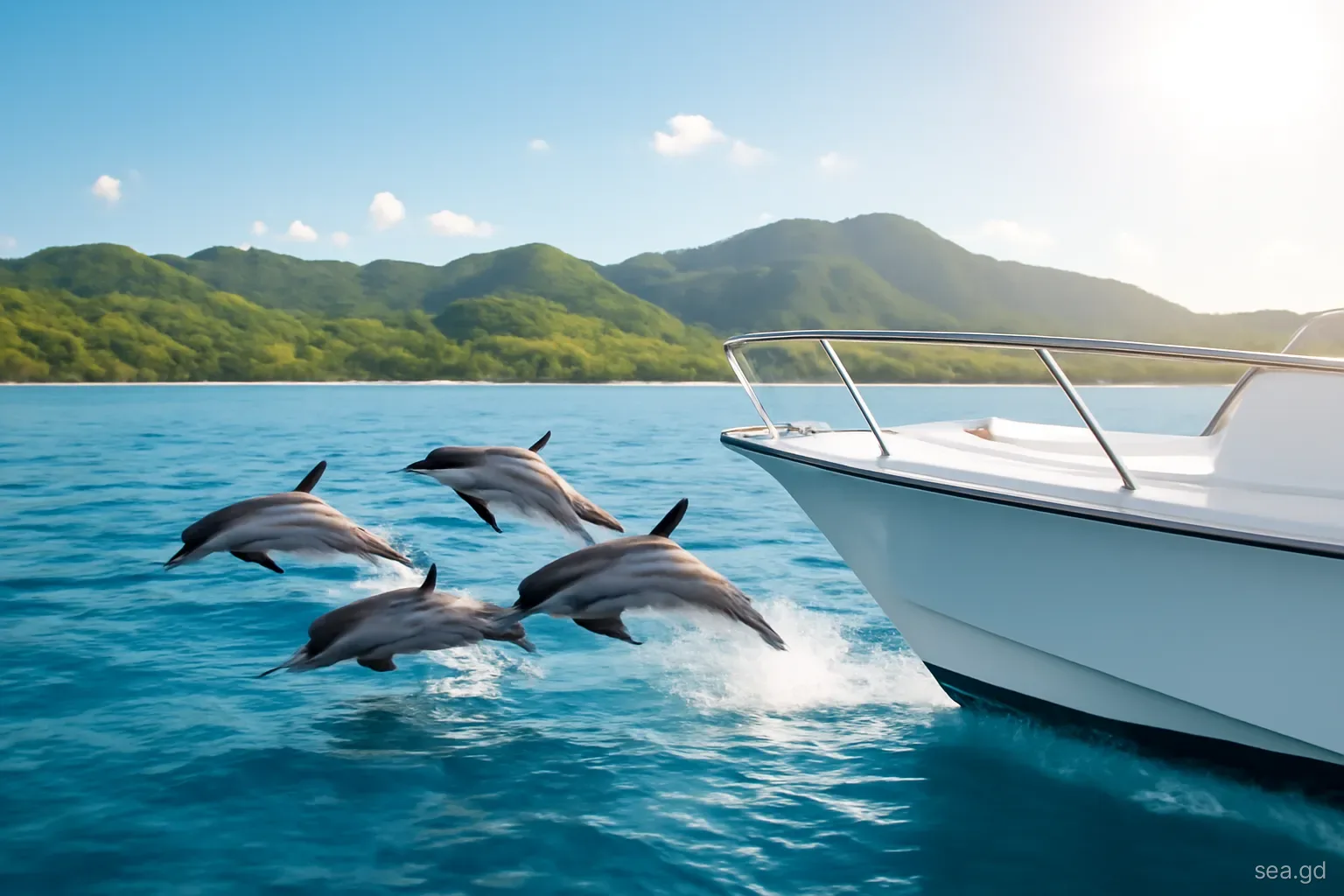
Grenada's west coast drops away fast. A few kilometres off Grand Mal or Gouyave the water is already hundreds of metres deep, and that steep slope into the Grenada Basin brings oceanic animals unusually close to shore. Sailors crossing to Carriacou, fishers heading out at dawn and divers on the boat back from a reef regularly report dolphins, and on some days pilot whales or sperm whales surface within sight of the hills.
None of this is guaranteed, and Grenada does not have the organised whale-watching industry of Dominica. But with some idea of which species live here, how to recognise them and when the seasonal visitors pass through, a boat trip becomes a decent chance of seeing marine mammals. The rules for doing it without harassing them matter as much as the identification.
Dolphins you are most likely to meet
Spinner dolphin. Slender, with a long thin beak and a three-toned body: dark grey back, lighter sides, pale belly. Spinners travel in pods that can number in the dozens or more and are famous for leaping clear of the water and twisting several times in the air. They often rest in calmer water by day and feed offshore at night.
Pantropical and Atlantic spotted dolphins. Both species start life unspotted and gather spots as they age, so a pod can contain plain young animals and heavily speckled adults together. The Atlantic spotted is stockier; the pantropical is slimmer with a white-tipped beak. Both bow-ride readily, which is how most sailors meet them.
Bottlenose dolphin. Larger and more robust, uniformly grey, with a short thick beak. Bottlenose dolphins in the Caribbean include both coastal and offshore types, so they can appear close to bays as well as in deep water. Pods are usually smaller than those of spinners.
Fraser's dolphin. Less familiar but recorded in the region: a stocky dolphin with a very short beak and a dark band running from the eye to the flank. Fraser's dolphins travel fast in tight, splashing groups and tend to stay in deep water, so they are more of an offshore sighting.
The whales: pilot whales, sperm whales and humpbacks
Short-finned pilot whales are among the most frequently reported whales in the southern Caribbean. They are black or dark grey, four to six metres long, with a bulbous rounded head, no visible beak and a broad, sickle-shaped dorsal fin set well forward on the body. Pods rest at the surface in a loose line, a behaviour called logging, and can look like a row of floating logs until one blows. In neighbouring St Vincent they have long been hunted, which is a reminder that attitudes to whales in the region are not uniform.
Sperm whales use the deep water west of the island chain throughout the year. The giveaway is the blow, which angles forward and to the left rather than straight up, and the long, wrinkled grey back that sits low at the surface for several minutes between dives. When a sperm whale goes deep it arches and lifts its broad triangular tail flukes clear of the water, then may stay down for close to an hour.
Humpback whales are seasonal. They migrate south from feeding grounds in the North Atlantic to breed and calve in warm Caribbean waters in the winter and spring, roughly January to April. Most of the breeding population concentrates further north, but humpbacks pass along the Windward Islands and are seen off Grenada and the Grenadines in those months, sometimes breaching or slapping their very long white pectoral fins on the surface.
Recognising what you are looking at
Most sightings last seconds and happen at a distance, so identification comes down to a handful of quick clues. Train your eye on these before you go out.
- The blow: a tall, bushy blow suggests a large baleen whale such as a humpback; a forward-angled blow from one side of the head means sperm whale; small dolphins rarely show a visible blow at all.
- The dorsal fin: tall and curved on dolphins; broad, low and set far forward on pilot whales; a small hump followed by knuckles along the back on humpbacks and sperm whales.
- The head: long thin beak on spinners, short thick beak on bottlenose, no beak and a round melon on pilot whales.
- Behaviour: spinning leaps mean spinner dolphins; bow-riding is typical of spotted and bottlenose dolphins; motionless logging at the surface is typical of pilot and sperm whales.
- Group size: large, splashy pods are usually dolphins; whales tend to appear singly or in small groups, although pilot whales can travel in larger family pods.
- Tail flukes: a humpback's flukes have a black and white underside pattern unique to each animal, and researchers in the Caribbean use photographs of them to track individuals across seasons.
Where and how to look
Most encounters happen on the leeward side, between St George's and the northern tip of the island, and in the channels between Grenada, Carriacou and the smaller Grenadines. The Atlantic coast is rougher and less often searched. Sailing yachts on passage, fishing charters, and occasional dedicated dolphin and whale-watching trips run by local operators account for most sightings; there is no fixed timetable, so ask locally what is running.
Choose a calm day. Spotting a fin or a blow in whitecaps is extremely difficult, and on a flat sea a pod of dolphins is visible from a long way off. Early mornings often give the calmest water. Polarised sunglasses cut glare, and binoculars help you confirm a distant splash before the skipper changes course. Watch for seabirds working the water: feeding birds often mark schools of bait fish, which attract dolphins and tuna alike.
Patience is the main skill. A full morning offshore may produce nothing, or three different species. Keep expectations open and treat any sighting as a bonus rather than the point of the trip.
Watching without harassing
Grenada's wildlife rules are not as detailed for marine mammals as those of some neighbouring islands, but the widely used Caribbean guidelines are straightforward and a responsible skipper follows them.
- Approach slowly from the side and slightly behind the animals, never head-on and never by driving into the middle of a pod.
- Reduce speed to a crawl within a few hundred metres and keep a respectful distance, commonly around 100 metres for whales and 50 metres for dolphins, unless the animals choose to approach you.
- Let dolphins come to the bow if they want to; keep a steady course and speed rather than turning sharply to follow them.
- Limit the encounter to around half an hour and avoid crowding: if several boats are already watching, stand off or leave.
- Never try to swim with whales or jump in among a pod. Mothers with calves are particularly sensitive, and close approaches can separate them.
- Do not throw food or anything else into the water, and keep noise down; engines and shouting both carry far underwater.
Common mistakes on a wildlife boat trip
Choosing on price alone. The cheapest trip may be the one that chases animals hardest. Ask how the operator approaches marine mammals before you book.
Forgetting the sea. Deep water off the west coast means real swell. Take seasickness tablets before departure if you are prone, not when you start feeling ill.
Expecting a show. Wild animals keep their own schedule. A trip that promises sightings is promising something nobody can deliver.
Standing in the wrong place. On a small boat the best view is usually from the bow or a raised deck, but moving around while the skipper manoeuvres is how people fall. Pick your spot early, hold on and let the crew tell you when it is safe to move.
Leaving the camera in the bag. Sightings are brief. Have the camera on, the lens cap off and a fast shutter speed set before the animals appear, or simply put the camera down and watch.
Not recording the sighting. A quick note of date, position, species and group size, with a photo of a dorsal fin or tail if possible, is useful to researchers and conservation groups working on regional marine mammal records.
Frequently asked questions
Can you see whales from the shore in Grenada?
Occasionally, from high points along the west coast on calm days, but sightings from land are rare and usually distant. A boat in deep water a few kilometres offshore gives a much better chance, especially for dolphins, pilot whales and sperm whales.
When is humpback whale season in Grenada?
Humpbacks migrate into the Caribbean in the northern winter and spring, roughly January to April. Grenada is south of the main breeding concentrations, so sightings are not daily, but they do occur along the island chain in those months.
Are there dolphin-watching tours in Grenada?
Some local boat operators run dolphin and whale-watching trips, and fishing charters and sailing trips often encounter dolphins. Offerings change, so ask locally. Pick an operator that follows distance and approach guidelines rather than one promising guaranteed sightings.
Is it legal to swim with dolphins in Grenada?
Swimming with wild dolphins and whales is strongly discouraged by conservation guidelines because it disturbs resting and nursing animals. Responsible operators do not put swimmers in the water with them. Check current rules with the Fisheries Division if you plan a trip specifically for this.
Were whales ever hunted in Grenada?
Shore-based whaling took place in parts of the Grenadines in the late nineteenth and early twentieth centuries, and the remains of a whaling station survive on Glover Island off the south coast. Today a small humpback hunt continues only in Bequia, in neighbouring St Vincent and the Grenadines.